
The Indian peninsula witnesses a collective dance of joy each year as the oppressive summer heat recedes and ocean winds usher in the clouds. This is a seasonal shift that shapes the year ahead for hundreds of millions, and its spectacular journey begins on a single, blessed strip of land: the southwestern tip of India, in Kerala.
As if guided by an ancient, heavenly clock, the monsoon traditionally makes its grand entry here on the first of June. A delay of even a day or two sets the old-timers’ eyebrows raising in the tea shops. The newer generation has grown accustomed to glitches in this clock, courtesy of shifting climate patterns, but the anticipation remains electric.
When the rains finally hit, they arrive like impolite guests—starting with a sudden, thunderous bang rather than a polite drizzle to let you prepare. Yet, they are gentlemen at heart; they keep their word and they arrive.

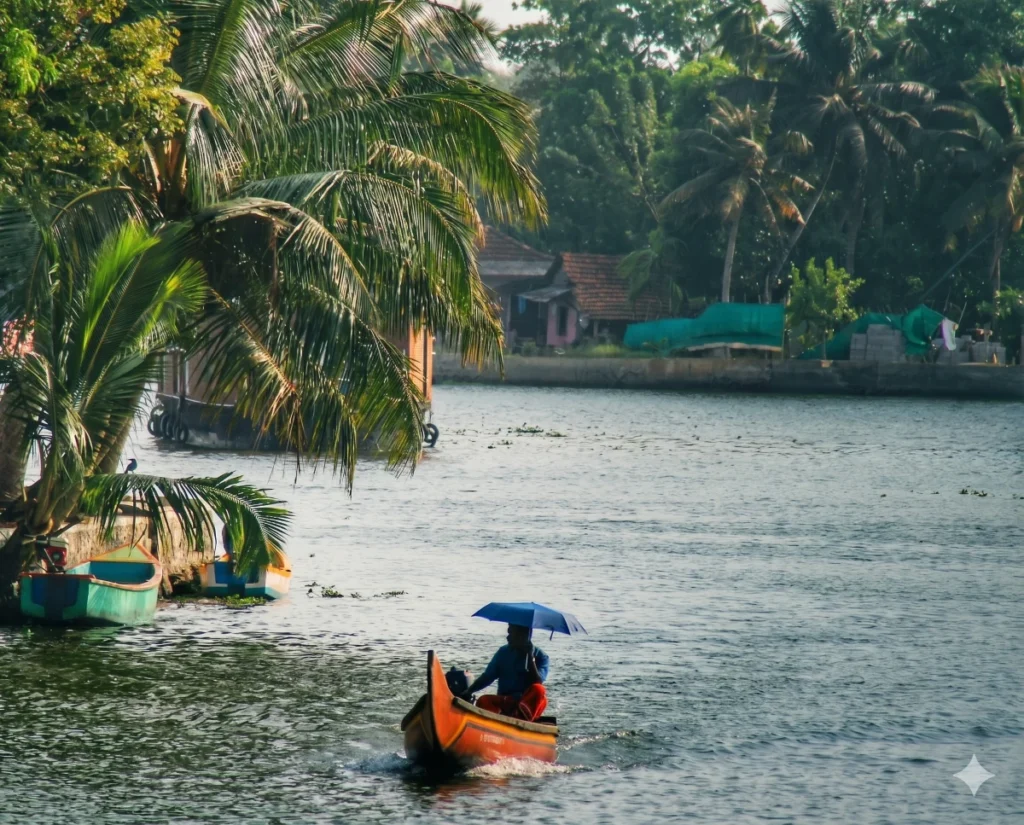
Out in the villages and towns, life abruptly changes gear. Overnight downpours leave their signature in the grey morning light. The leaves of the coconut trees drip rhythmically, and the moss-kissed compound walls lining the narrow roads glisten.
Then, after a brief rest in the darkness, the clouds gather fresh energy. The downpour picks up speed, and the humble human companion takes center stage: the kuda.

Umbrellas open in a magnificent, synchronized wave. Office-goers waiting at the bus stands reach into their bags to unfurl classic black canopies. Schoolchildren pull out vibrant, bright shields of pink, blue, and green, some emblazoned with superheroes or cartoon cats. Carpenters and masons emerging from the lanes join the main road, merging seamlessly into a moving camouflage of nylon and steel.
On these wet mornings, the country roads of Kerala become a delightful dance of unfurling umbrellas. They pop open like a time-lapse video of mushrooms emerging from damp earth. The rhythm is unmistakable, and the steady pitter-patter of raindrops landing on stretched fabric becomes celestial music.
The umbrella is perhaps one of civilization’s most quietly indispensable inventions. As far back as the eleventh century, bamboo and paper canopies shielded walkers in China. Today, lovers walk arm-in-arm beneath them on the cobbled streets of Paris; a gracefully aging grandmother carries one through the mist-lined alleys of Yorkshire toward the local library; and farmers in the emerald fields of Vietnam wear them like hats. But in this laid-back state of South India, the umbrella is not merely utility—it is a culture.
The Kerala umbrella story
It is a massive market. Imaginative television ad jingles start running a week before the clouds arrive, serving as a far more accurate weather predictor than the local meteorological bureau. With nearly 120 days of precipitation a year, it is no wonder that, by some estimates, almost half of all umbrellas sold across India are bought right here in Kerala. From the heavy, brass-handled walking-stick models favored by the elderly to the sleek, triple-fold designs of young professionals, everyone carries their own portable roof.
Underneath this colorful canopy, the walk to school becomes exactly what the journey of life ought to be: slow, but with a spring in the step. Kicking into puddles, children beam at the world, their shirts damp where the raindrops slant inward with the wind.
The gloomy, grey morning transforms into a living, breathing musical, leaving you humming that 1960 classic sung by Lata Mangeshkar:
O sajana barkha bahar aayi / Ras ki puhaar layi, ankhiyon mein pyar layi.
(Oh my beloved! The rains have come, bringing a shower of nectar and love to my eyes.)
Lata’s voice lingers like the rain itself—gentle, insistent, impossible to ignore. I step inside for hot coffee, the steam rising in tandem with the mist outside. And as the first sip warms me, I realize the monsoon has rewritten Kerala’s script once again: turning umbrellas into dancers, puddles into playgrounds, and mornings into music.
For a traveler, it is more than weather; it is a reminder that joy can arrive unannounced, thunderous, and yet utterly faithful..