
Travelling around the Tamil heartland, I have reached Srirangam. The Kallanai Grand Anicut still lingers in my imagination. The river has tagged along, and now it is the Sri Ranganathaswamy Temple that is on the itinerary.
This was to be the highlight of the trip this year.
The temple stands on an island formed by the Kaveri and the Kollidam rivers. The rivers flow unhurriedly , for they know where they are going, and the Srirangam temple stands watching, in all its elegance. Huge walls stand guard in reverence.
It is a land which breathes history. A playground to thousands of stories, myths and legends.
The earliest mention of a temple here dates as far back as the 1st century CE . It is during the exalted Chola reign, around the 10th century, that the Ranganathaswamy Temple becomes an important centre of the Vaishnava tradition.
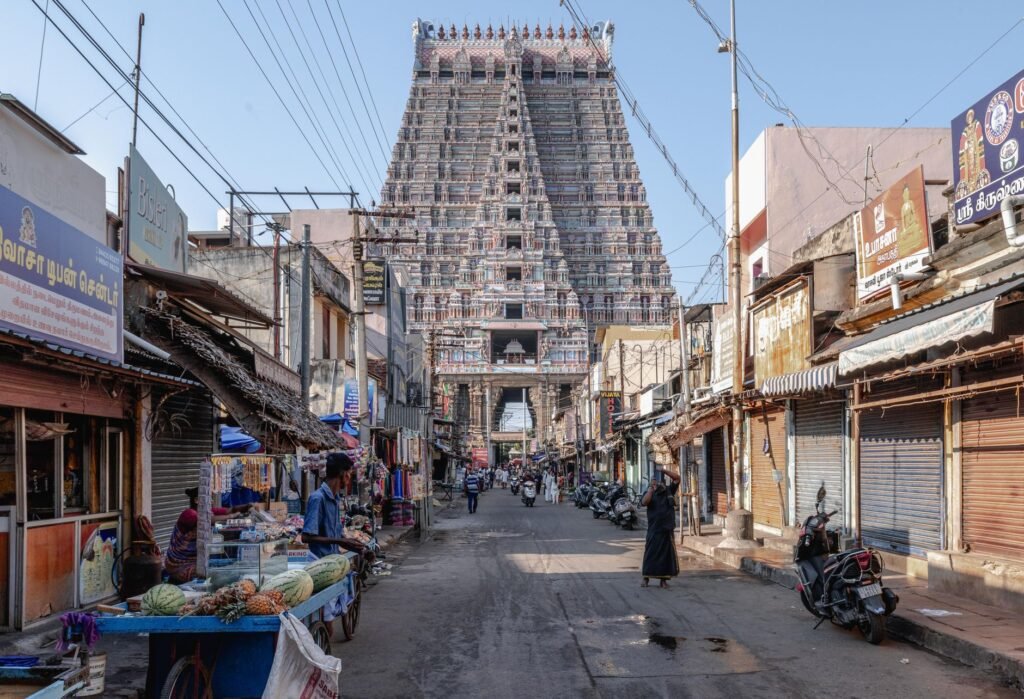
Just outside the wall, life is quietly chugging away. A wizened old man sits outside a thatched and broken cafe, sipping coffee. Children, barefoot and carefree, are throwing stones at a flock of pigeons, and car drivers are looking for parking spaces. Little did I know that the inside was no different.
A soothing silence prevails. Soft tones of ringing bells can be heard from deep within. The chimes waft over the walls. They aren’t calling; they seem to just remind you of their presence.
Some places announce themselves loudly. Not Srirangam.
Srirangam waits. It does not summon you. It assumes you will come when you are ready.
Srirangam: When Ranganatha decided to stay put
The origins of the Ranganathaswamy Temple are older than recorded memory, and yes, there are many versions of how the reclining idol came here.
One of them says the idol of Lord Ranganatha , Lord Vishnu reclining on the serpent Adi Shesha was gifted to the Ikshvaku dynasty of Ayodhya and found its way through many royal hands to reach the banks of the river here at Srirangam.
The other story, which is heard more often, is more mystical. It is said that the idol was being carried by Vibhishana to Lanka. He stopped here, on the banks of the Cauvery, to perform his daily prayers. When he tried to lift the idol again, it wouldn’t budge. The deity, it seemed, had chosen the quiet serenity of the land and decided to stay.
Historical inscriptions place active construction and patronage from as early as the 10th century CE, under the Chola kings, who regarded this temple as the jewel of their spiritual world.
Over the centuries, the Pandyas, Hoysalas, and Vijayanagara emperors each added their devotion in stone.
Seven Rings to the Divine
The temple is built across seven concentric rectangular walls or seven prakarams as they are called, each one drawing you closer to the innermost sanctum. It is a design of philosophical elegance:
- The outermost enclosures are a functioning town. Shops selling flowers and prasadam, small homes, a school and even a post office.
- The middle enclosures grow quieter, commerce and common life give way to the devotional.
- The innermost rings are a different world entirely . It is cooler, dimmer, and smelling of camphor and old stone.
The Chola kings who conceived this were not just building a temple. To me, it seemed they built a journey from the more human outer layers to the divine presence in the centre. Someone’s idea to create the obvious differential.
A symbolic journey from the ordinary pursuit of life in the outer sections to surrender to the divine. They were building a journey of human life in search of meaning that one could walk through.
Walking Into Srirangam
It is early morning. The river mist is still around, and the sunlight plays around lightly. There are few people around. They walk beside me as we step into the temple. Some look happy and some distracted. Young and old couples walk in silence. Those with children are shushing the brats as they chatter away.
The seven prakarams are enclosures that are geometrically aligned. Each enclosure pulls you further inward, away from noise, away from the outer world. Houses appear. Shops stand open. Children running barefoot. Cows standing stubbornly in the shade. Life here does not orbit the temple; it exists within it.
Stone corridors stretch endlessly, pillars aligned perfectly. The stones and walls speak without actually speaking. If you stand in silence, leaning against the walls, you will get the point. The space you stand in has witnessed innumerable chapters in the eternal flow of time. They tell you stories of kings who gave generously, of poets who wrote from the heart, and, of course, of invasions that scarred.
This is a living museum open to the air, it breathes.
Deeper still, the air changes. The smell of incense thickens. The noise dies down. Somewhere above, the Pranava Vimanam rises , gold catching the light, simply reflecting what is already there. It is said that seeing it is enough. That belief feels understandable.
The Ayiram Kaal Mandapam or the Hall of a Thousand Pillars stuns you. Every column is different. There is almost a frenzy in the carvings on those pillars.
Horses in mid-leap and celestial figures are everywhere. There are various guardian-like figures. Everything is expressive; every inch of stone retains its glory. It is as if thousands of years of wet monsoons and dry summers had just whizzed by.
Inside the sanctum, at the centre of it all, Lord Ranganatha reclines. Eternal. Unhurried. There is no drama in his posture, no urgency in his gaze. There is a stillness that is profound.
The priests walk around going through their daily routines. Some are pouring oil into the lamps that are everywhere. Flowers are being strung to make garlands.
Meanwhile more people are coming in. There is an air of devotion as people silently move towards the sanctum.
Once you are at the doors of the lord, you stand in awe. The huge idol is the highlight here. Vishnu resting on Ananta Shesha. The representation of Vishnu in yog nidra overseeing the cosmic cycle of creation.
Some are here to pray for answers. Some for relief. Some say nothing at all. The deity accepts them equally. There is nothing that divides, and it all just adds up.
The Lord had made up his mind to stay here an eternity ago, and there shall be no changing of minds.
I get the Srirangam Puliyodharai — the temple’s famous tamarind rice prasadam. It is, they tell me, even today made from the same recipe it has always been made from. Some things here are simply not interested in changing.
By midday, the temple is loud. Bells clang in overlapping rhythms. A loudspeaker somewhere recites a Divya Prabandham verse on a loop. Pilgrims move in long, patient queues towards the sanctum.
The noisy kids are now tired, some sleeping in the arms of their mothers and the others dragging themselves along rather laboriously.
The stones beneath my feet are now heating up, and the heat in the air is a notch up.
It is time for me to leave the silence, serenity and divinity of this sanctum of faith. It is time to get back.
The eternal wait continues
One of the small surprises of Srirangam is how alive it looks. You don’t feel it right away , but then you sense the fact that , ancient does not mean grey here.
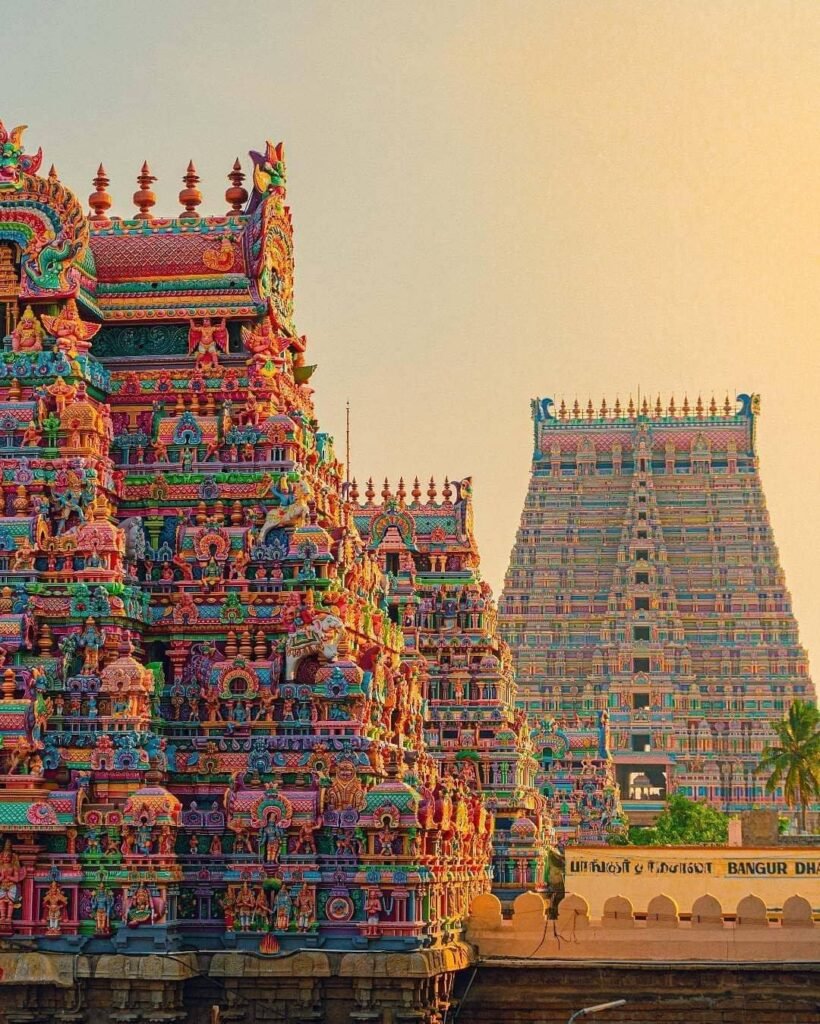
The gopurams are ablaze with colour . There is saffron, white, and deep red too. For centuries the temple has used natural pigments: turmeric, lime and herbal extracts passed down through families of craftsmen who were appointed to continue the work. For them it was more divine calling than just work.
The Ranganathaswamy Temple has survived the Delhi Sultanate’s raids, the hiding of its sacred idol for 48 years, colonial indifference and the slow erosion of centuries. It is still here. Still functioning. Still receiving people.
That is not just survival. That is something closer to a promise kept.
As I leave, I can feel Srirangam behind me. Waiting for more people like me to come find solace and leave in peace. A cycle that might still be repeating a few thousand years from now.
One can hear a few bells ring from outside the wall. A few people are going in while I step out and that is the cycle. People come and go and Srirangam waits.
The next stop is the Arulmigu Jambukeswara Temple, a few miles away. It is another world, a playground for some more of those mystical and mythical dramas.