Kerala Football and it’s colors
A sport is much more than those fleeting hours of action on the field; it leaves an enduring imprint on the society around it. It is never really about the results, the final scores, or the titles won and lost.
Those are just statistics, destined to be crowded out and forgotten as time passes. What makes sport deeply human is the profound effect it has on those who follow it.
I am currently on my annual break, driving through the countryside. The arrival of the rains was the trigger for this getaway, and they are fully upon us now. The drive from Bangalore to Kerala is smooth, the traffic thinning out delightfully once the city limits fade away. But the moment I cross the border into Kerala, I notice something unmistakable.
Football fever has arrived.
The World Cup in Kerala
While people in the cities usually watch the World cup games tucked away in their homes, leaving the streets bare, Kerala is entirely different. Just a few kilometres into the state, the symptoms of this fever become visible. Huge flags of the perennial favourites are strung high across the roads. The vibrant yellow of Brazil shines brightly through the overcast, wet weather. The iconic Argentine stripes show up everywhere, and Portugal’s red flutters in the wind.
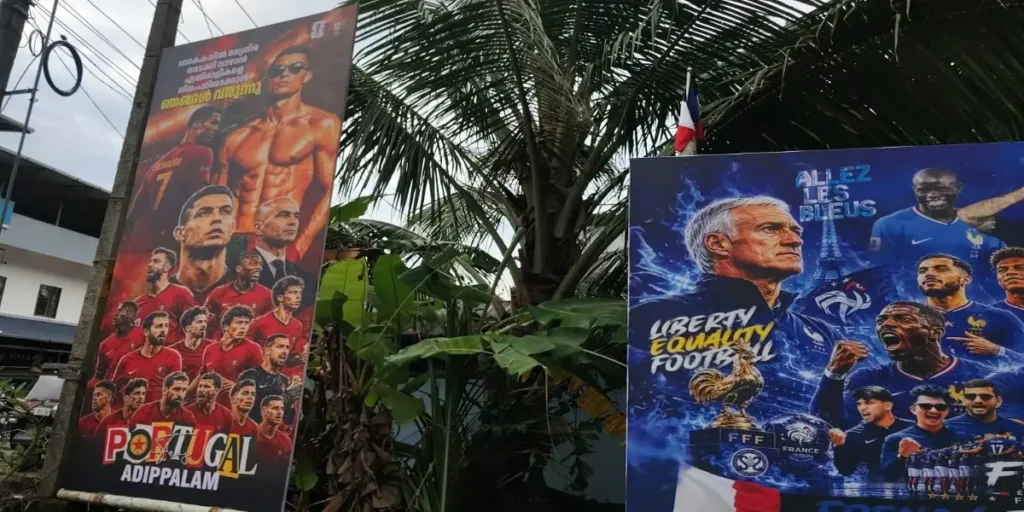
I am on the way to Kannur for my first stop. The roads are lined with gigantic posters. Massive cut‑outs of Messi, Ronaldo, and Neymar stand in waterlogged fields. Local fan clubs pool their money just to put up these hoardings of their heroes. Every hundred meters, a new team poster demands attention. Messi kissing the World Cup trophy takes center stage in many, while the imposing figure of Emiliano Martínez looms large alongside him. Ronaldo is right there too, sometimes bare‑chested, showcasing his rippling muscles.


Kerala loves the Brazilian samba, and it shows. On a 30‑by‑10‑foot poster, the entire Brazilian team appears. Neymar sits on a throne, while Carlo Ancelotti, cigar in hand, stares out across the paddy fields—a testament to local anticipation. Kerala cannot ignore its love for Brazil. If they do not win the World Cup, offices and schools would be empty, and flags probably flown at half‑mast.
Yet, the Kerala football fan is not just passionate; he is sensitive. Diogo Jota is not forgotten here, smiling gently from the Portugal poster—a poignant tribute to a tragic story of missed opportunity. Harry Kane and Bukayo Saka appear in a few paddy‑field posters. The English are struggling both on the field and in the land of football posters. A few posters with Didier Deschamps and his ominous group also jostle for space amongst the wet landscape. The other teams are barely represented.

But then, most of them play football, while the South Americans live the game—and that is what connects to the human psyche.
Kerala Football Culture
Kerala is a rare state where football successfully outstages cricket. In India, that is no mean feat. While cricket is catching up, football remains the real deal here. Small grounds tucked around local temples host fierce six‑a‑side matches, and artificial turf grounds have cropped up everywhere.
It was the success of the Kerala teams at the Santosh Trophy in the 1980s and 90s that rooted the game into the state. Kerala has a massive diaspora working in the Gulf (UAE, Saudi Arabia, Qatar, etc.). Returning expatriates brought back a passion for global football and European clubs, embedding international football and especially World Cup fandom into the state’s culture.
But it is the World Cup that truly stirs the soul of the Malayali. While global leagues are followed diligently throughout the year, the World Cup is what brings football pouring onto the streets.
The usual commercial hoardings peddling washing machines are aggressively pushed aside. Even advertisements for gold loans now feature the likes of Mbappé and Neymar. How can one resist buying a pendant when Messi urges you to?

The rain pours heavily as I drive through the countryside, but there is absolutely no dampening of the enthusiasm that comes with the tournament. The posters are everywhere, all the way as I make my way back to the hotel.
Being here, I felt an undeniable urge to be a part of this collective madness; just watching it on television simply wasn’t enough. I hadn’t expected to feel it too — years of covering this sport from the outside, and somehow the paddy fields got to me before the posters did.
Buying Football Jerseys at Kannur
So, I did the next best thing. I sat down to write about the fever gripping the state, and then I went out to buy a few football jerseys.
The street that the hotel sits on has a line of shops selling football jerseys. They just dominate the display. The elderly shopkeeper knows the look in the eyes as I walk in. Two of his young assistants attend to me.
“Do you have the brilliant orange Dutch jersey?” I ask. “Or the Japanese baseball-styled away kit?”
The young man gives a wry smile.
“We have sold most of them,” he says. “Now we have only the fast-moving ones”.
Now, I had to make a choice. I have been watching and writing about football for years, and the choice had to be right. The real challenge, however, was choosing whose name should grace the back of my shirt. A little thought made the decision surprisingly easy. The whole world was sporting Messi, Ronaldo, and Neymar. Even people with just a passing fancy for the sport were jumping on that bandwagon; it felt more like a fashion statement than true love for the game.
My choice, I felt, needed to be a bit more nuanced.
In the end, the choice was beautifully simple: Luka Modrić, the diminutive magician from Croatia.
The understated conductor of the midfield orchestra, and quite easily one of the finest footballers I have ever had the privilege to watch. A man who, outside of his lone 2018 triumph, has been so unjustly overlooked for the Ballon d’Or for years. One who should actually be close to the heart of a populace who appreciate the philosophy of the game.
I asked for a Modrić jersey. The assistant paused, then smiled. “Croatia,” he said, as if that explained something. Perhaps it did.
He dug into the pile behind him and came up with the Modrić shirt. It was now mine. It was slightly too big, smelling of new fabric, and exactly right.
My own roots are in the southern part of this state, where the love for football runs quieter, more relaxed and sober. But what I found today in Kannur, in the north, was something else entirely, it was not just fondness for the game, but a fever for it, worn on sleeves and hoardings and the backs of a hundred strangers.
Perhaps that is the imprint sport really leaves, not on the scoreboard, but on a man in India driving home in the rain, and a Croatian legend’s jersey folded on the seat beside him.
Now, all I need is a headband and a flowing lock of hair.