

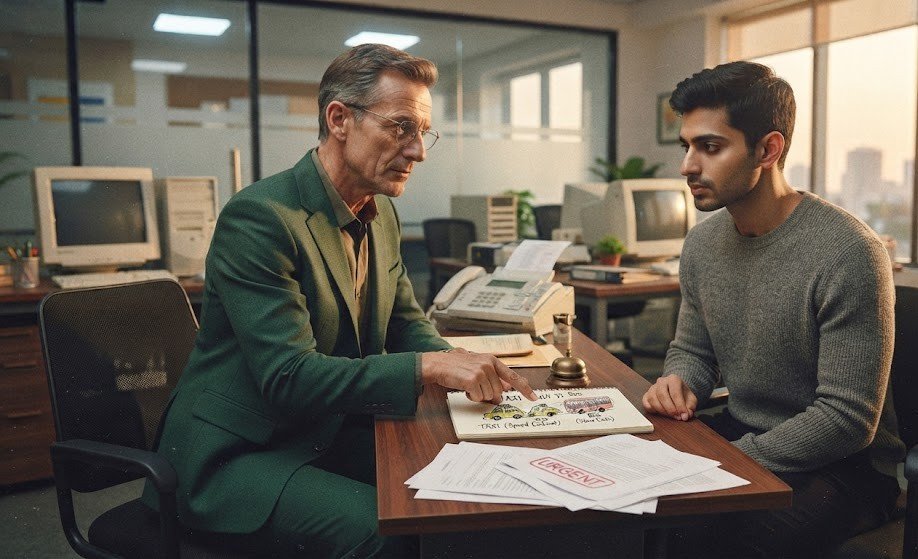
It was a routine morning in the office. Little did I know that by the end of the day, I would receive one of the most precious pieces of advice of my career. It was a profound life lesson, delivered in the middle of a high-pressure situation.
At the time, I was a Project Engineer at the head office. I was responsible for everything from equipment dispatch to overseeing installation and the final client handover. It was the kind of role that taught you something new every day. With so many moving pieces, keeping an eye on everything was critical. Even a tiny error could have massive repercussions.
We had just bagged a huge order worth almost ₹7 crore (70 million INR) from a prestigious client. Our team had manufactured the equipment well ahead of schedule, long before any delay penalties could kick in.
Because of the size and weight of the machinery, we had to use enormous heavy-duty trailers to move it out. I had planned the logistics down to the last detail. The trailer was brought into the factory and parked right by the loading bay. But just a few hours before we were set to load, a diligent Quality Manager spotted an issue. It was serious enough to halt the entire dispatch.
A lot of head-scratching followed among the technical teams, and we concluded that the rectification work would take at least three days.
Because trailer availability was incredibly low at the time, we decided to keep the vehicle inside the factory until the issue was resolved. Three days passed, and we were still struggling to resolve the problem.
Unease began to creep in. Given the tight layout of the plant, the giant trailer was now blocking vehicular movement and eating up prime space. The elephant in the factory had officially become the center of office gossip.
On the fourth day, toward the end of the afternoon shift, the equipment was finally ready. I rushed to get the paperwork done so we could get the vehicle moving. The most critical task was generating the invoice accurately. The tax rules at the time allowed us to claim a tax credit of 12.5% of the invoice value, which required careful entry of even the smallest details.
As I was scurrying around trying to tie up loose ends, I was waylaid by Mr. Gokhale, the Vice President. He was the most senior man in my department, a rustic, pleasant man but capable of being short-tempered at times. He was a leader who existed in a corporate strata far above a junior engineer like me.
He stopped me in the corridor and, in front of a crowd of onlookers, launched into me.
It was a ten-minute tirade that sent me into an absolute panic. He railed about how the trailer was a pain in the back, screamed about how incapable my team was, and ended with a stark ultimatum: “You have until this evening to get it out, or you are done.”
Looking past his shoulder, I noticed a few colleagues watching the spectacle. I later found out they were the very ones who had gone to his office to complain about the blockage. That did not stop them from taking an interest in my predicament.
Terrified, I ran back to my desk, rushed through the paperwork, and managed to get the trailer out of the factory gates by evening. As the massive vehicle lumbered onto the road to begin its four-day journey to the client’s site, I let out a massive sigh of relief.
But the peace lasted only a moment. The next crisis arrived instantly.
Those same colleagues had been digging around in the system and discovered a tiny clerical error I had made in the tax documentation. It was a mistake that could completely jeopardize our ability to claim the tax credit. They promptly whispered it into the Vice President’s ear.
Mr. Gokhale marched down from the floor above and delivered a second dose of fury. This time, it was worse.
I was shattered. I could practically see the end of my career flashing before my eyes. I stood there sweating, terrified, with absolutely no idea how this would end. The exposure from that error was almost 9 million rupees. It was not looking pleasant.
In a daze, I rushed to the one place I thought I might find shelter: Mr. Gadgil’s office.
Seeing me sweating and visibly flustered, Mr. Gadgil calmly asked me to sit down and tell him the whole story. I spilled everything, trembling, waiting for the inevitable hammer to fall or for some immediate reprimand. Instead, the man rose from his seat, walked straight out of the room, and closed the door behind him.
I was left alone with my thoughts, wondering if he had gone to HR to discuss the best way to sack me. Ten minutes passed in agonizing silence. Then, the door opened.
Mr. Gadgil walked back in carrying two cups of hot coffee. He placed one in front of me and began almost irrelevant small talk about my roommates and my family back home. In the middle of a crisis, I couldn’t understand why he was talking about anything but the problem. The contrast was jarring , but it worked. The adrenaline slowly left my system.
Eventually, he stopped talking, looked at me, and asked, “Have you finished your coffee?”
“Yes, sir,” I replied.
He leaned back in his leather chair. “Now, think coolly. What can you do right now to save that tax credit?”
With my mind finally clear of panic, a simple solution hit me. “I can chase the trailer on my bike. I’ll catch him, get the documents back, bring them to the office to correct them, and hand the new copies back to the driver.”
It was incredibly straightforward, but my panicked mind had completely missed it.
Mr. Gadgil smiled. “Then go ahead and do exactly that. We will handle the VP later.”
I rushed out, jumped on my motorcycle, and sped onto the highway. A few miles down the road, I found the massive trailer parked by the wayside, the driver waiting for the heavy evening city traffic to ease before heading out. I retrieved the documents, raced back to the office, called a few colleagues for quick system support, and got the paperwork corrected.
By the time it was all done and dusted, it was past 8 PM. The office was pitch black and completely empty, except for Mr. Gadgil’s cabin. To my surprise, he was still sitting there, calmly reading the evening newspaper.
“Right, there you are,” he said, looking up. “I was waiting for you. All sorted?”
I nodded, exhausted but relieved.
He waved me into the chair opposite him. “Good. Let us talk now. Do you realize the mistake you made today?”
“Yes, sir,” I said quietly. “I got completely muddled up under pressure from Mr. Gokhale and made a hasty decision. The trailer could have easily departed tomorrow morning with the perfect paperwork, and we wouldn’t have risked the credit.”
“Exactly,” Mr. Gadgil said. “Now, let me tell you a fundamental truth about life. But before that, let me ask you a question.”
He leaned forward. “If your father calls you and asks you to meet him at the city centre as soon as possible, would you take a cheap, slow bus, or a pricey, fast taxi?”
“A taxi, definitely,” I replied.
“And if your college roommate calls you to come watch a movie?”
“A bus,” I laughed. “He’s probably just calling me out for a casual drink and a movie. Nothing life-altering.”
Mr. Gadgil tapped the desk. “Yes. That is it. The taxi buys you speed, and speed costs money. You pay for it when time truly matters and something precious is at stake. So whenever you have to decide under pressure, ask yourself: does this involve your mother, your father, your siblings, or a few irreplaceable friends?
Is there something genuinely important that cannot wait?”
He paused to let it sink in. “If the answer is no, first make sure the decision is safe and ethical. Then set aside the emotion and the panic, and reduce it to numbers: what does each option cost, and what does it risk? If you had applied this when Mr. Gokhale was yelling at you, you would have calmly said no. Rushing the paperwork put almost ₹90 lakh at risk, while waiting until morning cost nothing.”
In all my years in the corporate world, I never received better advice on handling pressure.
I thanked him sincerely and stood up to leave. As I walked toward the door, he called out one last time. “You have seen the consequences of poor precision today. Now, for God’s sake, don’t come in tomorrow morning and become like many others in this building who stop making decisions altogether out of fear. Keep making decisions , just start taking them the new way.”
I walked out to the parking lot, and he followed shortly after. I started my motorcycle, and he rolled down the window of his car to wave as he drove away.
I sat on my idling motorcycle for a long time, thinking about what had just happened and the masterclass in leadership I had just witnessed. There had been no anger from Mr. Gadgil, no screaming, no corporate toxicity. Just a mentor taking the time to let a young engineer settle down, learn, and grow.
Not everyone does that. Believe me.
Mr. Gadgil didn’t just save my career that afternoon; he taught me once again how to think, not what to think.
You could read that story here. ( The Sheet of Paper )




Very nice advice and well written
Thanks Jal