

Imagine an empire so massive it ruled over nearly the entire Indian subcontinent, boasting a formidable army, sophisticated firearms, and seemingly endless wealth. Now imagine a kingdom in the northeastern corner of India that successfully thwarted this juggernaut not once, not twice, but an incredible 17 times.
This isn’t a fantasy script; it’s the real history of the Ahom Dynasty of Assam. Between 1615 and 1682, the Ahoms fiercely defended their sovereignty against repeated Mughal invasions. While the Mughals possessed overwhelming numbers, the Ahoms possessed a unique, brilliant ally: the treacherous and volatile Brahmaputra River.
Turning Geography Into a Weapon
The Mughals were masters of open-plains warfare, relying heavily on cavalry charges and heavy artillery. However, the terrain of Assam—filled with dense forests, rugged hills, and the massive Brahmaputra River network—rendered standard Mughal tactics entirely useless.
Instead of fighting the Mughals head-on where they would easily be crushed, the Ahoms utilized riverine guerrilla warfare (known locally as Dagga Yuddha). They understood a fundamental truth: a massive army requires a massive supply chain. By tracking the Brahmaputra’s erratic movements, the Ahoms constantly cut off Mughal food supplies and communication lines, forcing the invaders into unfamiliar, swampy terrain.
Engineering the Perfect River Trap
The monsoon season was the Ahom Kingdom’s greatest tactical window. When the heavy rains hit, the Brahmaputra would flood violently, turning the surrounding plains into thick, impassable mud. The heavy Mughal horses and armored soldiers sank into the mire, making them sitting ducks.
The Ahoms also engineered highly specialized boats called Bachari boats. Unlike the massive, lumbering Mughal warships, Bachari boats were long, lightweight, and highly maneuverable. Ahom soldiers could swiftly navigate the shallow channels, execute lightning-fast ambush strikes on Mughal ships, and disappear into the misty riverbanks before the enemy could even pivot their massive cannons.
The Climax: The Battle of Saraighat (1671)
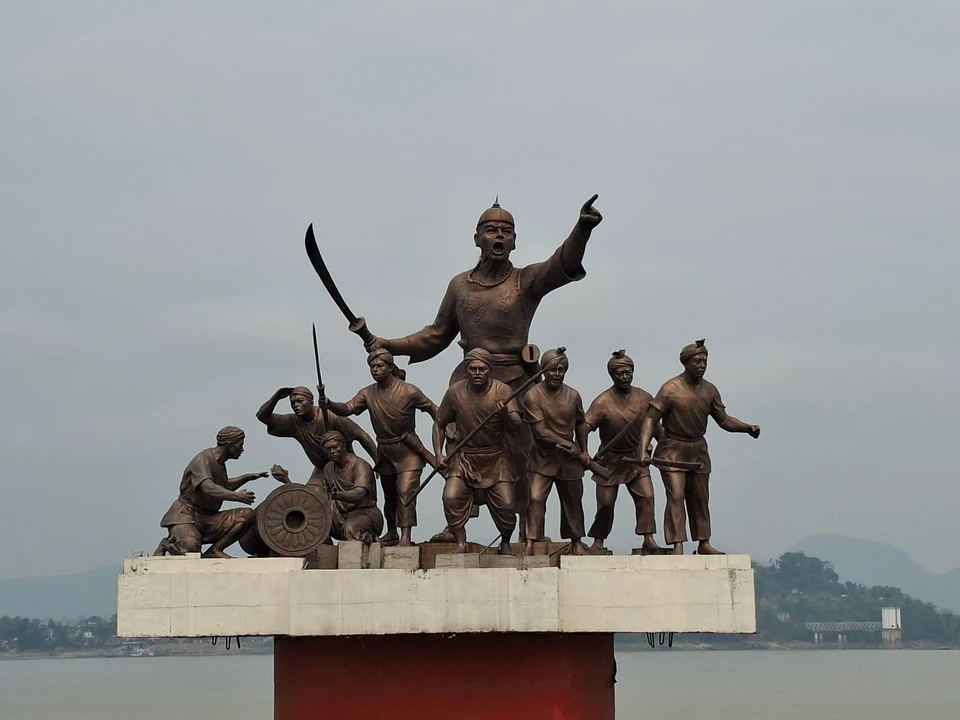
The ultimate test of this river strategy came during the legendary Battle of Saraighat in 1671. Led by the brilliant Ahom General Lachit Borphukan, the Ahoms faced a massive Mughal force commanded by Rajput Raja Ram Singh.
Recognizing that his land forces stood no chance against the sheer size of the Mughal army, Borphukan forced the Mughals into a naval showdown at Saraighat, the narrowest point of the Brahmaputra River. This brilliant bottleneck completely neutralized the Mughal numerical advantage.
“My country is greater than my uncle.” – Lachit Borphukan, after executing his own relative for neglecting the construction of a crucial earthen defense wall before the battle.
Borphukan built an intricate series of mud embankments and hidden stockades along the river. When the Mughal fleet entered the narrow channel, the Ahom forces launched a coordinated amphibious assault. Using their superior knowledge of the river’s complex currents, the lightweight Ahom boats smashed into the congested Mughal fleet, creating total chaos and forcing a decisive Mughal retreat.
A Legacy Written in Water
The Ahom victory wasn’t just a stroke of luck; it was a masterclass in asymmetrical warfare. By treating the Brahmaputra River not as an obstacle, but as the centerpiece of their military strategy, the Ahom Dynasty preserved their independence for nearly 600 years. They proved that no matter how mighty an empire might be, they are no match for people who know how to turn the very earth and water beneath their feet into a defensive shield.