
Uttarakhand is mystical, beautiful, and humbling too. We are in Kumaon and planning an unforgettable Munsiyari road trip over the mountains.

It was supposed to be a long drive to Munsiyari; the indispensable Google Maps said that. The mountains don’t ease you in. One moment you’re on a reasonable road, and the next, the hills have swallowed you whole.
Leaving Kausani and the Twists of the Kumaon Roads
We left Kausani in the early morning, Google Maps confidently promising a six-hour drive to Munsiyari. What it couldn’t promise—what no app ever could—was what those six hours would actually do to you. Having spent a few unhurried days in the sleepy, charming towns of Almora and Kausani, we were ready to go higher.
Munsiyari had been chosen almost on a whim—it sat closer to the Himalayas, it looked extraordinary on the map, and sometimes that’s reason enough. The distance was about 165 kilometers. The altitude at the other end: 2,200 meters. The drive, as the maps were already hinting, was going to be a slow one.
As morning broke, we drove out of Kausani and headed northwest. Like most roads in Kumaon, this one snaked out of town and promptly dipped downhill—a roller coaster that would take us all the way down to the small temple town of Garud before continuing its descent toward Bageshwar. In these hills, you rarely go anywhere in a straight line. The road has its own ideas.
Past Bageshwar, yet another of those ancient temple towns that dot this landscape like punctuation marks, the clouds began to darken.
One can still see some Golu Devta temples , much smaller than the Chitai Golu Devta temple. The Bageshwar temple is the more important one in this area.
The air carried a hint of rain. The temperature dropped, quietly and without drama, the way things tend to change in the mountains. One can spot small houses scattered across the hillsides. As we climbed the mountains, they grew smaller and smaller until they looked like tiny dots.

The Uttarakhand mountains.
After another half hour of driving and the terrain changing, we are now climbing. The roads are narrower, and the mountains grow in size. The climb is relentless, and the valleys get deeper. The green and blue-topped houses spread out on the stepped hill base grow smaller.
Everything is small. The hills are enormous, dwarfing all that is around them. Many of the hills in the distance seem like giants, resting peacefully under pine-covered blankets and watching us struggle.
A snaking river appears in the distance as we go around the wave of hills coming at us. For a brief period, we go down a mountainside along a road carved from a stony face and get down to the river. Now it is the other way around; the peaks are far away in the skies, we are deep in the valley, and the feeling of being tiny hasn’t changed. A metal bridge takes us across the river, and the climb begins again.
It is relentless; there is no respite as the mountains keep coming up and just get bigger by the minute. The weather has changed again; the sun is out, but the wind remains cold.

Sitting back in the rear seat as the hills loom large, you realize the sheer insignificance of us human beings in the larger scheme of things. The proportions are all skewed, and we are nowhere. It is just the misplaced arrogance of modern man that seems to blind all of us to this glaring fact.
First Glimpse of the Panchchuli Range
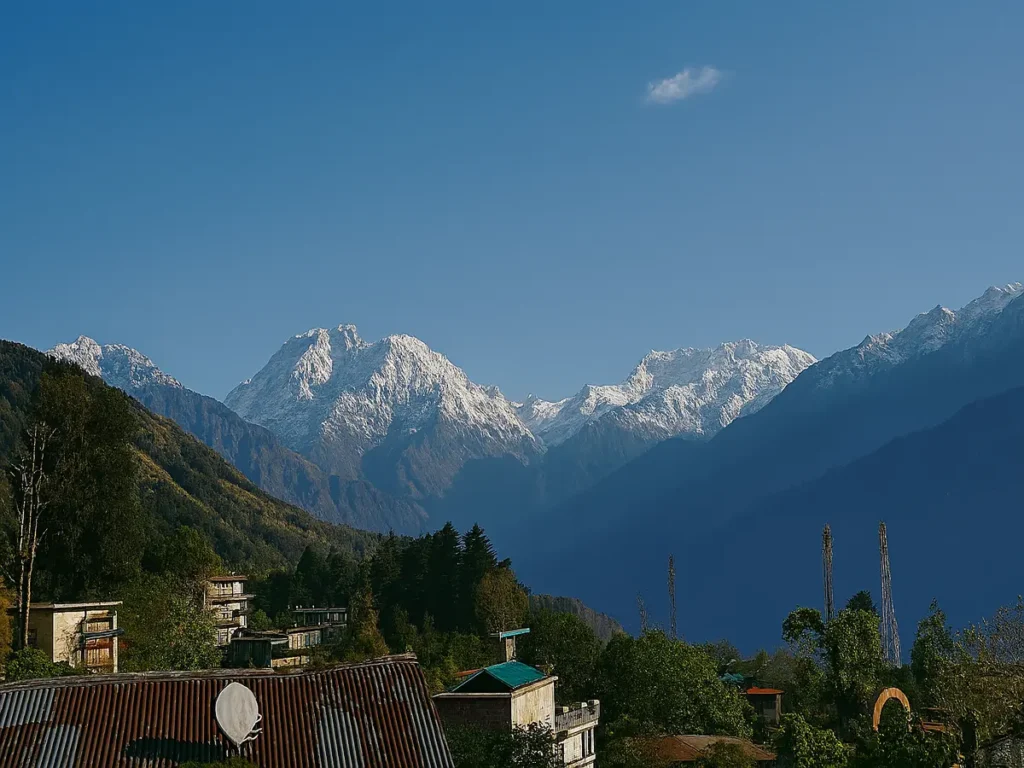
With just 20 kilometers to go to Munsiyari, the mood changes. The stern-looking, rocky mountains have now softened a bit as the air gets a bit chilly and the snow-capped mountains start peeping out from behind the hills.
The famed Panchchuli range starts to assert itself—taller and wider, looking like well-dressed gentlemen in white coats. It is a better roll now; the jerks are ignored as we take in the beauty through the car windows.
To someone from the plains who is used to the heat of Central India, this is pure succor. Perhaps a bit too cold, but still a great escape.

Our Munsiyari road trip ends under the stunning Panchchuli mountains
Driving for almost an hour, with the peaks keeping us company, we turn around the last climbing bend and ease into Munsiyari. It is a town with a few hotels, catering mainly to the hikers who haunt the place.
The town is hardly a street or two long. Small, tin-roofed shops dominate the streets. Many rooms are piled on top of each other, offering homestays and inns. Men in jackets are walking around; they seem to be guides who will take you up into the hills. Just beyond the streets are a few houses and shops dealing in everyday wares, sitting a bit below road level.
Above the road level, as you lift your eyes, you face the real deal.
An array of mountains blanketed in snow stands majestically. They are gracious in their welcome while reminding you of the fact that you are just an irrelevant, short-time traveler in the midst of their infinite time span.
Welcome to Munsiyari.

P.S. Having spent a day and a half in Munsiyari, it has to be said that this is not a place for middle-aged, frail weaklings like me! It is a place for the guys who are tough enough to trek around it. For those bravehearts, it would be a world of fun and adventure.
But then, in life, the journey is often more fun than the destination.