
A short drive from Ratnagiri is Ganpatipule, a small village disguised as a town. It sits beside a long stretch of golden beach, facing the Arabian Sea.
Amongst the many small temples and centres of local faith and devotion scattered around Konkan, Ganpatipule is probably the most revered and visited. The Velneshwar temple, located a few hours north, is another equally important site in the Konkan.
To someone who has seen the temples in the southern part of India, these appear modest in their architectural style. While dynasties like the Cholas took temple architecture to dizzying heights with majestic stone structures, intricate carvings and an almost unimaginable grandeur, the temples in Konkan reflect a mood of quiet reverence.
A temple for them was probably more of a social epicentre, where the presence of the Almighty blessed marriages and other social events.
The Ganesha temple at Ganpatipule is perhaps the most prominent of them. It stands right on the beach, just where the small hillock dips into the beach. A white tapering shikara looks out into the ocean. The base part is mostly reddish brown, the colour of the laterite pigment that is a common sight in these parts. The old wadas and houses around the countryside also have a reddish-brown look. The pigment was widely used in the art forms of Konkan.
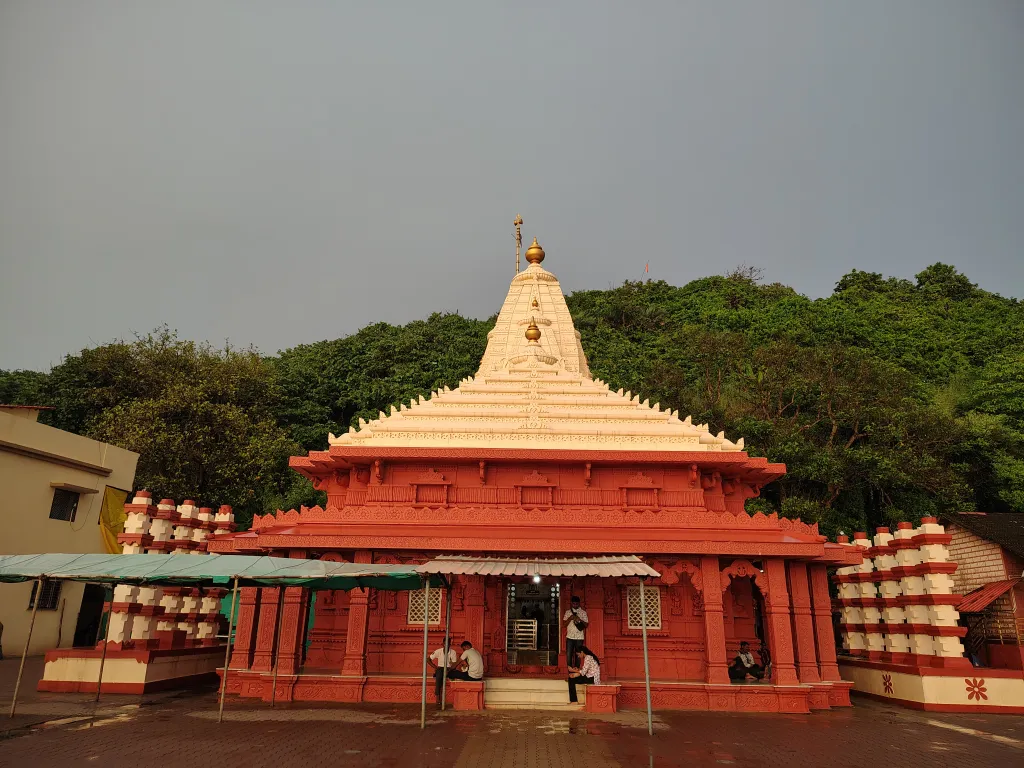
The very Konkan style of wall and mural painting, Kaavi Kale, utilised the reddish-brown pigment referred to in the local language as Kaav, with Kale (kala) meaning art. One cannot miss this distinctive style, where reddish-brown sketches are painted on a whitish hue to decorate homes and temples.

The temple, standing rather simply on the seashore, is an important pilgrimage point.
As legend has it, it is through the self-originated (Swayambhu) idol that the elephant-headed god Lord Ganesha manifests here.
Origin Myths of Ganpatipule Temple
Local legends, many of them in fact, can be heard when you speak to the locals. The one that is more common is how the idol came to be miraculously found. A cowherd in the region noticed one of his cows releasing milk uncontrollably at a particular spot on the seashore. This was interpreted as a divine sign, leading to the unearthing of the idol of Lord Ganesha that had self-manifested (Swayambhu) from the sand. Said to have occurred several centuries ago, the idol is uniquely revered since it was not crafted by human hands but emerged naturally from the ground.
Unlike many of the temples in India, the idol faces westward. Looking out into the sea, and standing guard to the faithful.
Archaeologically, the Ganpatipule Temple is estimated to be around 400 years old, although local folklore and some historical links suggest that the idol itself may be much older, dating possibly over 1600 years. The temple’s structure and complex have seen many changes and expansions, with the Marathas playing important roles in the temple’s development.
Ganpatipule today is one of Maharashtra’s prime pilgrimage destinations, particularly famous for its Ganesh Chaturthi celebrations.
Divinity on the Seashore.
We reached the temple in time for the evening aarti. Dusk was descending, and after the darshan, we decided to wait for the evening aarti. It turned out to be a great call.
As the aarti time approached, the small prayer hall got busy. Tall, multiple-storied oil lamp structures were lined up. The guards handed out candles, and the devotees assisted in lighting the lamps. The lights from the lamp began to take hold.
Someone switched off bulb lights and the hall was all sparkling with the lamps lit. The bright lamps pushed back the darkness. It was quite a surreal feeling. The hall was quickly filled as men and women of all ages filled from nowhere. There were many young boys and girls, some slinging bags and probably on the way home after work.
The most obvious of the chants started to ring out. It was one I have been used to for most of my life spent in Maharashtra. Though that life seemed an eternity ago, the echo of that chant was as fresh as ever.
Sukhakrta Dukhkarta vartha vighnanchi….
A memory refreshed and a stunning transportation into an almost forgotten past. No worship of Lord Ganesha is complete without this Sant Ramdas aarti. The experience is almost indescribable as one stands there with hundreds of flickering oil lamps pushing the darkness away, and the devotees chanting along and clapping to the rhythm.
It was thirty minutes of an experience that makes this land what it is. On the seashore, with the sky light orange and darkness sliding in, the experience is even more enhanced.
A room echoing the chant, bright twinkling Oil lamps and the smooth and silent sea humming away in the background with the waves rolling in as if to pray.
While my entire trip to Konkan had been about rolling hills and mesmerizing landscapes up until now, standing there, lost in the ambiance, was a different experience.
That moment on that small patch of land on the shores of a mighty ocean was one of simplicity. A society continuing to respect its faith and belief.
This is what the real India is all about.
Not the India of monuments and headlines, but the India of small temples, familiar chants, flickering lamps and faith carried quietly from one generation to another.