

Kerala’s folklore remembers Perunthachan as a master craftsman whose skills bordered on the supernatural. His name is woven into stories of extraordinary temples, ingenious designs and a tragic legend that has endured for generations.
At Ulliyanoor Mahadeva Temple, near Aluva, his legacy is said to live on in a remarkable circular sanctum supported by an intricate wooden structure. Yet it is not merely the craftsmanship that makes this temple intriguing. A peculiar doorway, a pond steeped in legend and questions that seem to outlast the man himself invite us to look closer. What was Perunthachan trying to achieve, and how much of the story belongs to history?
Off the Kochi National Highway in the heartland of Kerala, just before the bypass to the industrial town of Aluva, a road quietly forks south. It’s easy to miss—lined with the usual clutter of shops, unhurried and unmarked—but follow it long enough and it leads to Ulliyanoor, a small island cradled by the bends of the Periyar River.
The Periyar has many such islands, but Ulliyanoor is unlike the others. This one carries a name, a legend, and the ghost of a man whose genius has never quite been explained.
The Legend of Perunthachan, Kerala’s Greatest Craftsman
Perunthachan, as the legend goes, was a master carpenter and sculptor whose ingenuity and skill were unparalleled. His mastery earned him the sobriquet Perunthachan—”Peru” meaning great and “thatchan” meaning craftsman. Though little is known about when he lived, Kerala’s folklore is rich with stories attributed to him. Some of his creations still stand today, inviting visitors to witness his extraordinary genius firsthand.
The most significant of these is the Ulliyanoor Mahadeva Temple, the jewel of this small islet, built on his own home turf.
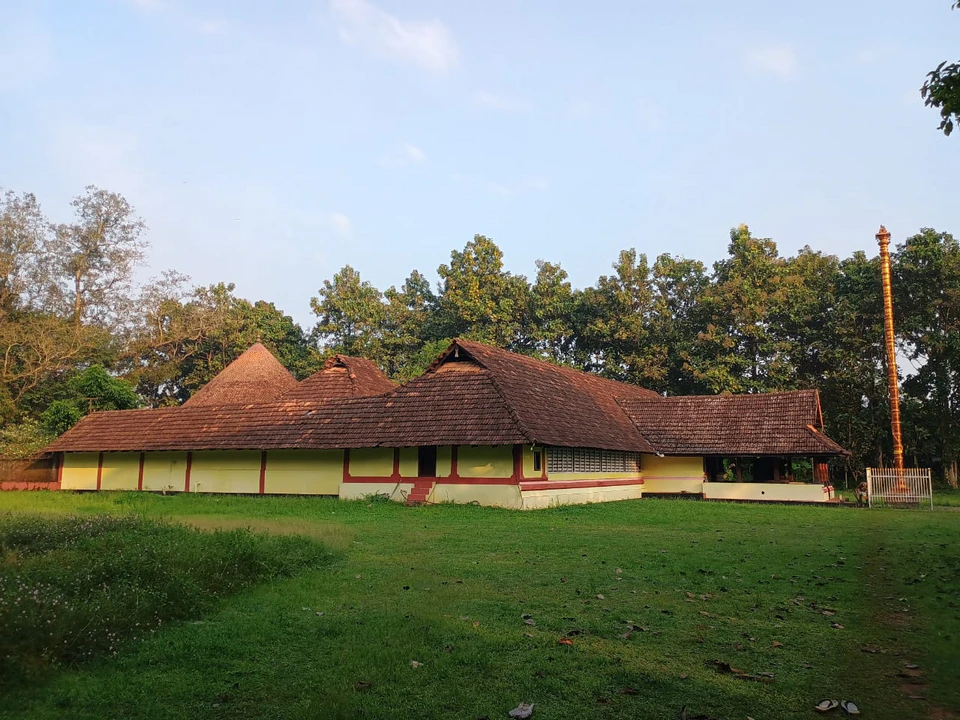
The Ulliyanoor Mahadeva Temple: Architecture Like No Other
On this sliver of land, beside a winding village road, lies a pond. It holds a story of its own—but more on that later. Adjacent to it, the temple gates beckon. Beyond the welcome arch stands what appears to be a typical Kerala temple: a towering flagstaff and a square structure with sloping tiled roofs enclosing the main shrine within.
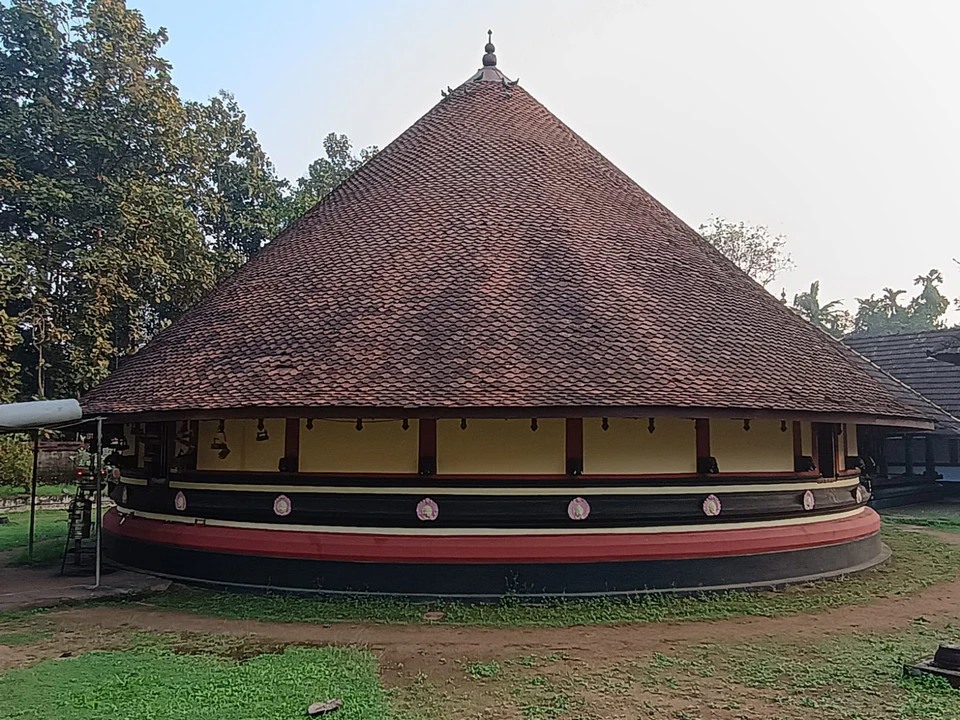
Perunthachan’s masterpiece rises at the centre—a circular sanctum crowned by a magnificent conical roof. What sets it apart is revealed only upon closer inspection. The temple is held together almost entirely through wooden craftsmanship of a mesmerizing order. A circular beam runs around the entire circumference, formed from arc-shaped pieces joined with wedges and wooden pins. From this base, sixty-eight vertical beams rise gracefully towards the apex, each wedged into a wooden, pot-like structure at the top with astonishing precision.
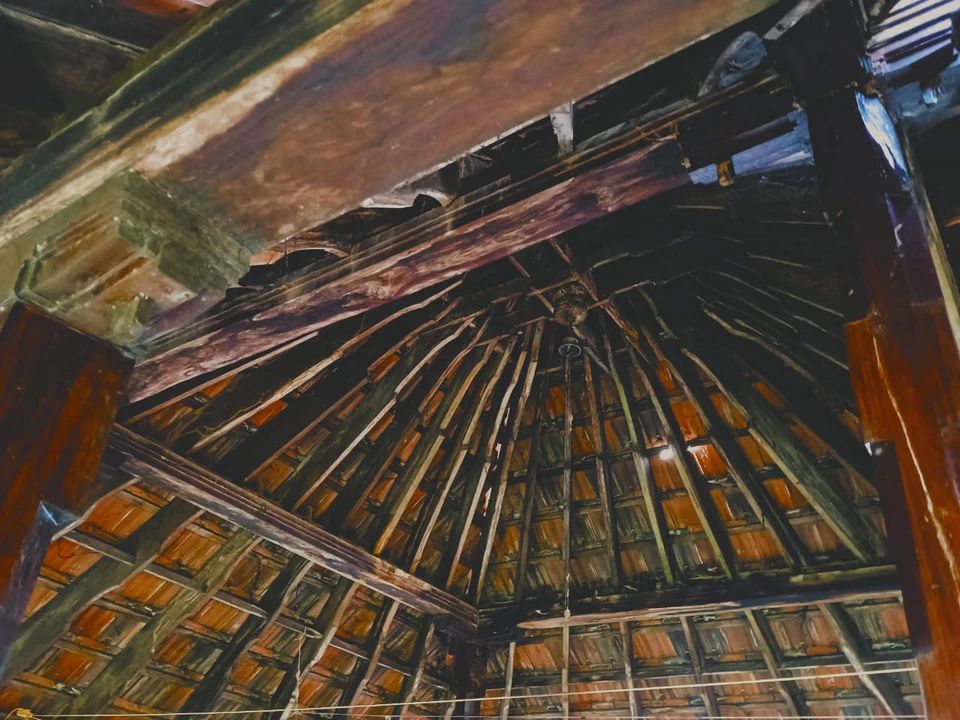
Access to the main sanctum is restricted, but the same technique is visible on the rectangular structure facing it, where the rising beams and wedge-held construction can still be clearly discerned by a careful eye.
Folklore holds that Perunthachan agreed to build this temple at the request of his fellow villagers, pouring all his wizardry into it. Every work of his, it is said, bore a mark of ingenuity, and this temple is no exception.
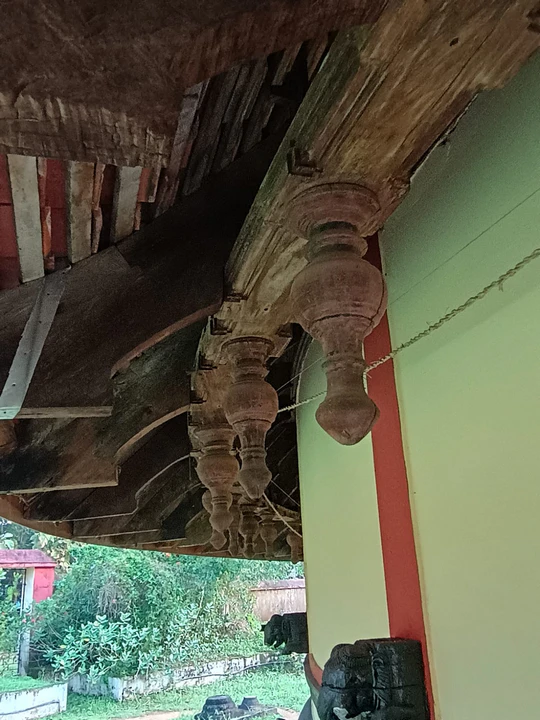
The Door That Defies Logic
The most perplexing piece of architectural magic lies at the entrance to the sanctum. To enter, the priest must stoop through a small, low doorway. But this is where Perunthachan’s mischief reveals itself. While going in, if the priest walks upright, his head strikes the roof. Yet when leaving, if he stoops to pass through the same doorway, his head hits the frame again. The only way out is to walk ramrod straight—entering stooped, exiting upright, through the very same door.
The angles of the beams and steps appear to have been calibrated to force this movement, though local tradition says no one has been able to replicate the effect precisely. It is an extraordinary manipulation of geometry, and an unmistakable signature of Perunthachan’s craft.
The Pond That Is Every Shape at Once
The temple grounds offer a genuinely soothing scene. Gleaming paddy fields on one side, trees on the others, and a carpet of green underfoot.
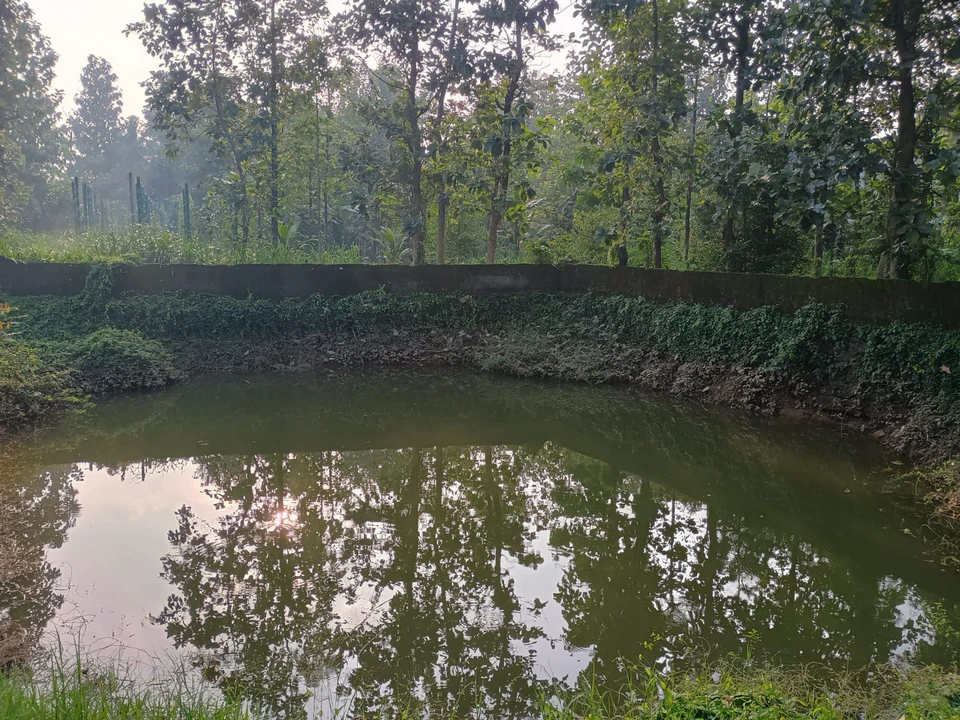
As you leave the temple, the pond stops you. Not because it’s beautiful ; it isn’t, not anymore. The walls are thick with moss, the soil crumbling at the edges, and thin green creepers slowly claiming what’s left. Time has not been kind here.
But the story it holds is worth pausing for.
When Perunthachan was asked to build a pond for the temple, the villagers couldn’t agree on its shape. Some wanted a square. Others insisted on a circle. The more mischievous among them demanded a triangle. Perunthachan, never one to be cornered, simply dug a pond that appeared to be all three, the shape shifting depending on where you stood.
The illusion is harder to read now. Years of neglect have softened the geometry and blurred the trick. But look carefully and traces of it still remain: two walls run straight, one curves, another tapers. A pond that was, somehow, every shape at once . The only man who truly understood it has been gone for centuries.
The Tragic End of a Master
The legend of Perunthachan endures, kept alive through stories passed down over generations, but it ends on a dark note.
His son, it is said, eventually surpassed him in skill. As the master aged and his son’s reputation grew, Perunthachan fell prey to jealousy. While working together on a temple roof, he dropped a chisel onto his son below. It struck the young man’s neck, and the wound proved fatal. Whether it was deliberate or accidental, the accounts differ. What they agree on is this: the act shattered the greatest craftsman of his time, and he died a broken man.
Perunthachan’s legend lives on, living in folklore, in temples, and in the curious angles of a doorway that no one has yet been able to fully explain.
While the more famous temples of South India, such as those at Srirangam and Thanjavur, built by the Cholas, are celebrated for their grandeur and magnificent stone architecture, the Ulliyanoor Mahadeva Temple is a monument to the wizardry of a single master carpenter.
As I leave the temple behind, I find myself wondering whether the pond could one day be restored to reveal its famous illusion once again. The temple itself is remarkably well preserved, but the pond deserves the same care. Some of our greatest stories survive not only in stone and timber, but in the places that quietly hold their secrets. They are worth preserving for generations yet to come.