
An interesting story from the Himalayas…
India is a land steeped in mysticism, where belief isn’t just a concept but an unapologetically lived reality. Long before modern ideologies took shape, the people of this ancient civilization revered nature as the supreme power. Even today, that deep-rooted connection to the natural world endures.
To an outsider, India can seem to defy logic — thousands of deities, the worship of trees, rivers, and animals. Yet every corner of this vibrant country holds its own living traditions and legends that have survived centuries. This is one of them.
Who Is Golu Devta? The Folk God of Justice in Uttarakhand
A few kilometers from Almora, in the northern Indian state of Uttarakhand, a remarkable legend lives on — deified, revered, and fervently prayed to by locals. It is the story of Golu, a young prince and son of King Hal Rai, betrayed by his jealous stepmothers at birth. The queens replaced the newborn with a stone and cast the infant into the river in a wooden chest.
Miraculously rescued and raised by a fisherman, Golu eventually returned to the palace as a young man to reclaim his rightful place — exposing the treachery of his stepmothers and earning renown for his wisdom and fairness.
Golu Devta is widely revered as an incarnation of Lord Shiva, the Destroyer in Hinduism’s holy trinity. Devotees believe he fulfills any sincere wish brought to him. Worshipped throughout the Kumaon region of Uttarakhand, dozens of temples are dedicated to his divine presence.
While golu may be a playful nickname for a mischievous child elsewhere in India, here he is a savior. For centuries, people have flocked to his temples seeking justice, solace, and fulfillment.
The Chitai Golu Temple: A Tapestry of Faith
The Chitai Golu Temple near Almora is arguably the largest and most celebrated of all Golu Devta temples — and visiting it is a genuinely surreal experience. Nestled against the hillside road, a few steps lead you into something unlike anything else in the Himalayas.
From the entrance to the idol, lining every path and hanging overhead, are bells. Thousands of bells — of every conceivable shape and size — dangling so low that visitors must stoop to pass through their shimmering curtain.
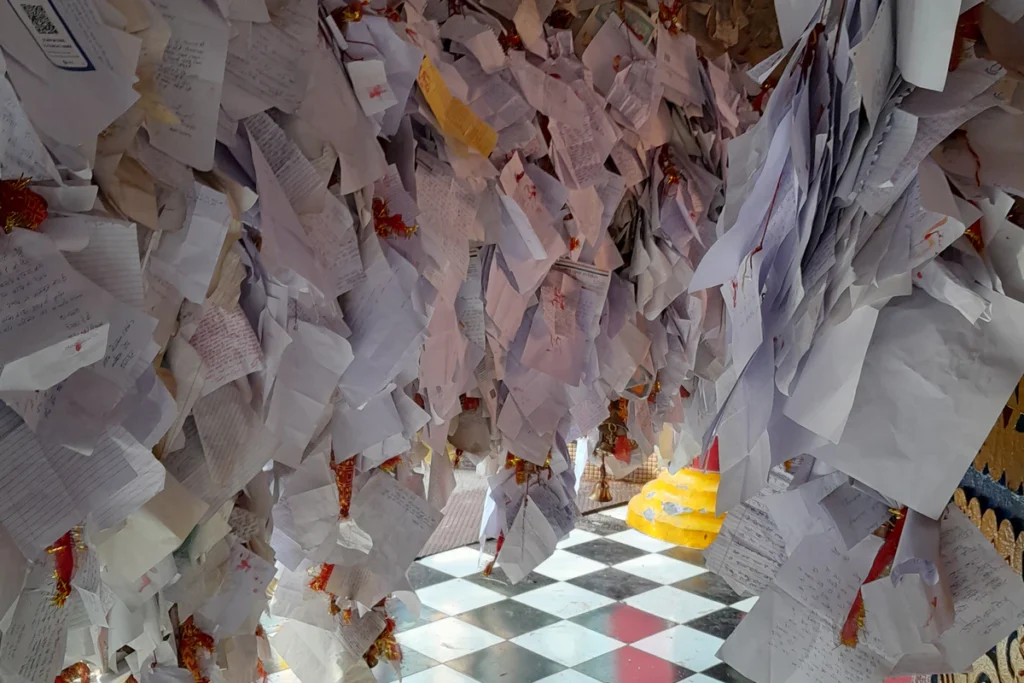
Each bell, by tradition, carries a handwritten letter of appeal: a devotee’s wish, written out in earnest and tied with a vivid red cloth. Some bells bear actual legal documents, placed by those entangled in court disputes. Others carry requests for exam success, recovery from illness, or resolutions to conflicts that the legal system has failed to address. It is a quietly moving experience — a silent, suspended archive of human hope, ambition, heartbreak, and longing.
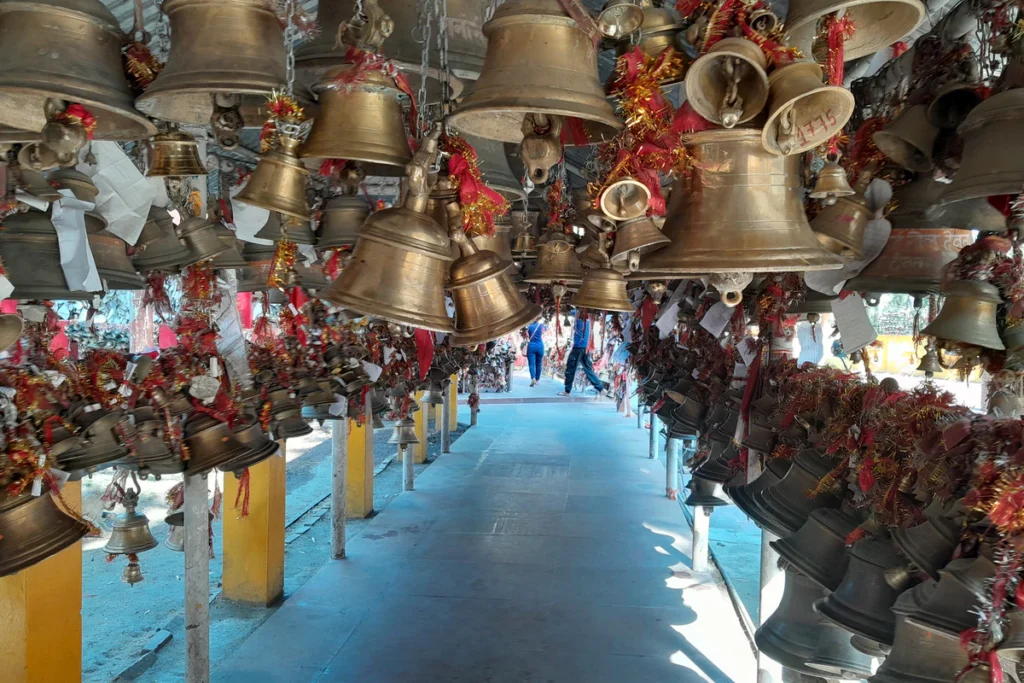
Here, in the shadow of the magnificent Himalayas, Golu Devta is believed to resolve all misfortunes. And the thank-you notes tied alongside many of the bells stand as deeply personal testimony to answered prayers. No case file numbers, no confusing legal paperwork, no expensive lawyers. Just unwavering trust — and a bell.
Faith in the Himalayas: More Than Just a Story
For city-bred skeptics, perhaps far removed from the mysticism that runs through India’s veins, this might read as a charming folk tale and nothing more.
But consider this: perhaps we have simply drifted away from something old and wise. In our rush to rationalize everything, we risk losing sight of the vast, beautiful mystery that surrounds us — the kind that was never meant to be solved, only respected.
As they say, faith can move mountains. In these majestic Himalayan foothills, it most certainly rings a bell — and makes sure it’s heard.
Whether one believes in miracles or not, the bells of Chitai Golu Devta temple remind us that hope itself can become a form of prayer.
If you are in Almora , do not miss paying your respects to Golu Devta.

Chitai Golu Devta Temple Travel Guide:
How to Reach and Nearby Places to Explore
The nearest airport to the Chitai Golu Devta Temple is Pantnagar Airport (120 km), while the closest major railway station is Kathgodam (90 km) on the North Eastern Railway line. The nearest local bus connectivity and taxi services are available directly from Almora (9 km), connecting seamlessly across the Kumaon region.
The best time to visit is March–June and October–November, when the weather is crisp and pleasant, avoiding the heavy monsoon rains and freezing winter chills. Within 150 km, you can explore Almora, Kausani, Binsar Wildlife Sanctuary, Jageshwar Dham, Ranikhet, and Nainital.
🏞️ Other nearby Places Worth Visiting
Within easy reach of the Chitai Golu Devta Temple, you can explore a stunning mix of Himalayan hill stations, ancient shrines, and wildlife sanctuaries across Kumaon:
- Almora (9 km): A historic cultural hub famed for its panoramic Himalayan views, colonial-era charm, and traditional Kumaoni cuisine.
- Jageshwar Dham (27 km): A sacred cluster of over 100 ancient stone temples nestled in a dense deodar forest along the bubbling Jata Ganga stream.
- Binsar Wildlife Sanctuary (25 km): A high-altitude sanctuary offering dense oak and pine forests, rich birdlife, and the famous Zero Point viewpoint for sweeping Himalayan vistas.
- Kausani (52 km): A tranquil hill station known as the “Switzerland of India,” offering magnificent 300-km panoramic views of snow-capped Himalayan peaks.
- Ranikhet (45 km): A serene cantonment town featuring pine forests, ancient temples, golf courses, and the Mankameshwar shrine.
- Nainital (65 km): A classic lake district town centered around the emerald Naini Lake, surrounded by rolling hills and vibrant local markets.