
Every organization moves through three seasons during its lifetime. In the way businesses are born and die these days, these cycles arrive faster than ever. They may not arrive in the order described, but they always come around.
The easiest phase is one of growth. Revenue climbs steadily, factories operate at full capacity, and profits are steady. The industry is booming, and optimism is in the air. Tall bars of green fill the charts, line graphs climb to the right, and words from physics like velocity and acceleration become buzzwords. Almost any strategy looks brilliant because the market tailwinds are helping.
Then comes a season of slight unease. The first quiet cracks appear. Sales deals are seem to be a bit more difficult to close. Costs rise despite the best efforts. A few frustrated employees quietly hand in their resignations. The market wants cheaper alternatives, and competition is ready to offer exactly the same. Nothing has collapsed, but the tone of hallway conversations changes. This is the stage where underlying weaknesses begin to surface, though most companies continue business as usual, hoping the friction will resolve itself.
In Season Three, the crisis arrives in full force. The market turns cold. Past mistakes catch up. The comfortable assumptions of earlier seasons no longer hold. The wolf could be at the door anytime. Survival now requires leaders to diagnose the real root causes of decline, no matter how uncomfortable those truths might be.
Yet, when faced with Season Three, many organizations choose to avoid the real problem altogether.
There is an old Mulla Nasruddin story that illustrates why this happens.
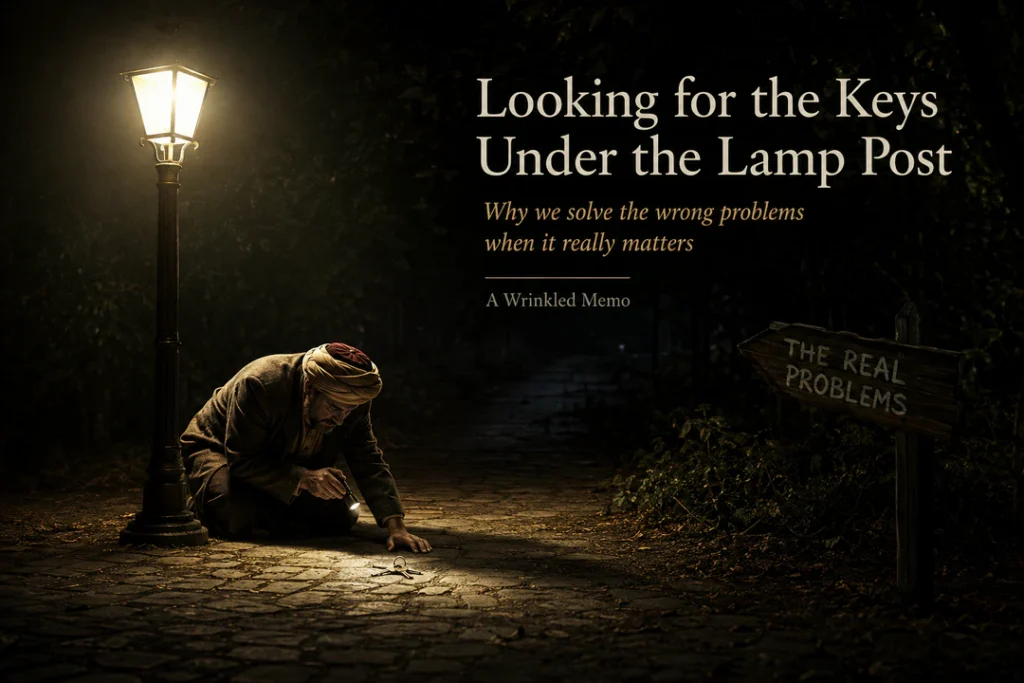
One evening, Mulla Nasruddin was walking home along a quiet road. As he approached a street corner, he noticed a man kneeling under a bright lamp post. He seemed to be searching for something.
Mulla stopped and asked, “What are you looking for?”
“I lost my house keys,” the man replied without looking up.
Mulla was tired after a tough day but decided to help. He joined the search and the two men spent a long time searching every inch of the bright circle of light, but found nothing.
Exhausted, Mulla finally paused and asked, “Are you sure you dropped them here? Where exactly were you when you lost them?”
The man pointed toward a dark patch of bushes several dozen yards away. “Over there, deep in the brush.”
Mulla looked at him in disbelief. “Then why are we searching out here under the lamp post?”
The man answered simply, “Because the light is so much better over here.”
Solving the Wrong problems
This is precisely how many corporate leaders react during a crisis.
The real problems are always out in the dark shrubs. They sit inside flawed pricing models, obsolete products, poor hiring decisions at the top, or toxic work cultures ignored during profitable years. Confronting those dark corners requires admitting past mistakes, having difficult conversations, and doing grueling, unglamorous work.
Because the dark is intimidating, leaders gather under the bright light instead. They launch organizational restructurings, introduce new slide templates, and order brand redesigns. These actions are visible, safe, and comfortable, but they do not solve the actual crisis. They treat the symptoms, not the disease.
In most cases it is a few hundred pin pricks that kill rather than a slice of a sword. No transfusion helps if the blood doesn’t clot.
Organizations survive Season Three only when leaders are willing to step away from the comfortable light and search in the darkness where the real problems reside. These are times when the pain of ripping off the bandage must be accepted as the start of a healing process.