

My college reunion brought me to the Tadoba Andhari Tiger Reserve. The two days of catching up with friends after a few decades were truly nostalgic. Stories were told, heard and retold as we ambled down memory lane, congested with millions of moments.
More about that another time.
There was something far more interesting that I learnt during one of our safari rides while we watched a few of those elegant cats. While we drove around we spotted the Ghost tree , a tree which changes colour around the year. ( Read here The Ghost Tree ).
It was a day of learning. Then came something I had never thought about before, nor imagined.. I had never thought there could be such an angle to a tiger sighting.
Have you ever looked at a tiger and thought, That is a very bright orange cat?
Well, if you have not, it is time you did.
An Orange Hunter in a Green World
Here is one of the most formidable hunters on Earth, dressed in a coat that, by all reasonable logic, should get it spotted from a mile away. In the deep emerald forests of India, where every shade of green competes with every other shade of green, a blazing orange animal ought to stand out like a street lamp on a dark village road.
You would think evolution would have sorted this out by now. A nice mossy green, perhaps. Or a respectable olive. Something that whispers forest rather than shouts look at me.
And yet, the tiger persists. In orange. And vanishes, almost at will, into the very undergrowth it seems so ill-suited for.
There is a reason for this. As it turns out, the answer lies not in what we see, but in what its prey sees.
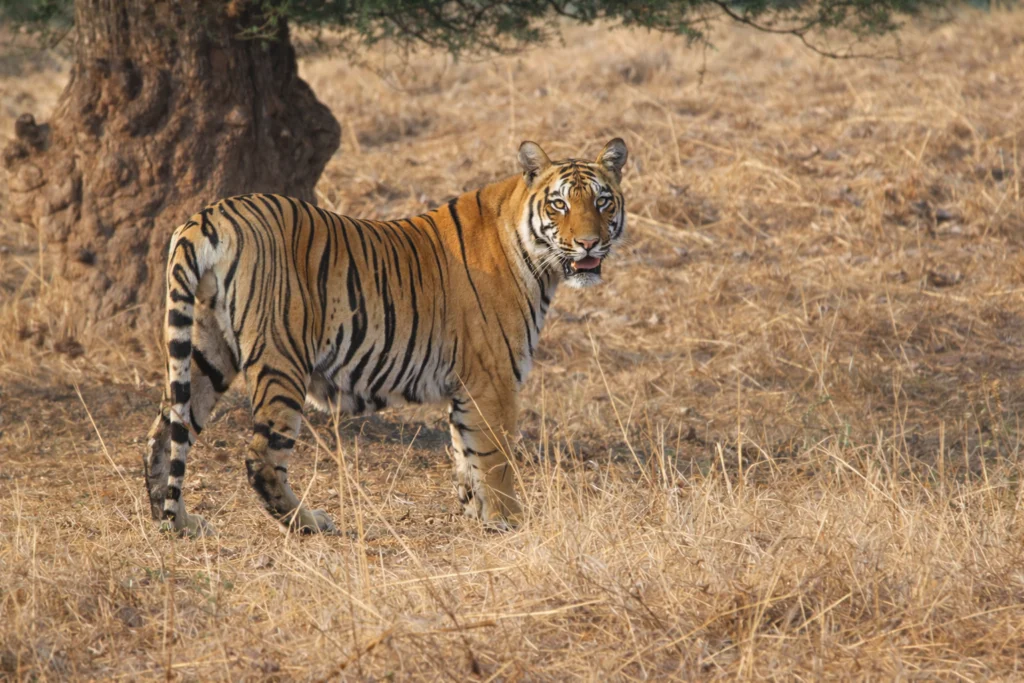
In matters of colour vision, we humans are rather fortunate. Our eyes carry three types of colour receptors—red, blue and green. This trichromatic arrangement allows us to perceive millions of shades. To us, orange and green are as different as chalk and cheese.
The spotted deer—the Chital—and the Sambar, both staple prey for the tiger, are not so richly equipped. Their eyes carry only two receptors. It is what scientists call dichromatic vision. They are, in effect, red-green colour-blind.
And here is where nature pulls off one of its most elegant tricks.
Seeing the Forest Through a Deer’s Eyes
To a deer, the colour orange simply does not exist. That magnificent, flame-coloured fur, the very thing that seems to announce the tiger’s arrival registers as a dull greyish-green. Standing motionless in tall grass, the tiger does not look like a predator. It looks like the background itself. Whether the grass is lush green after the monsoon or dry brown in summer, the deer is still at a disadvantage, one that is often fatal.
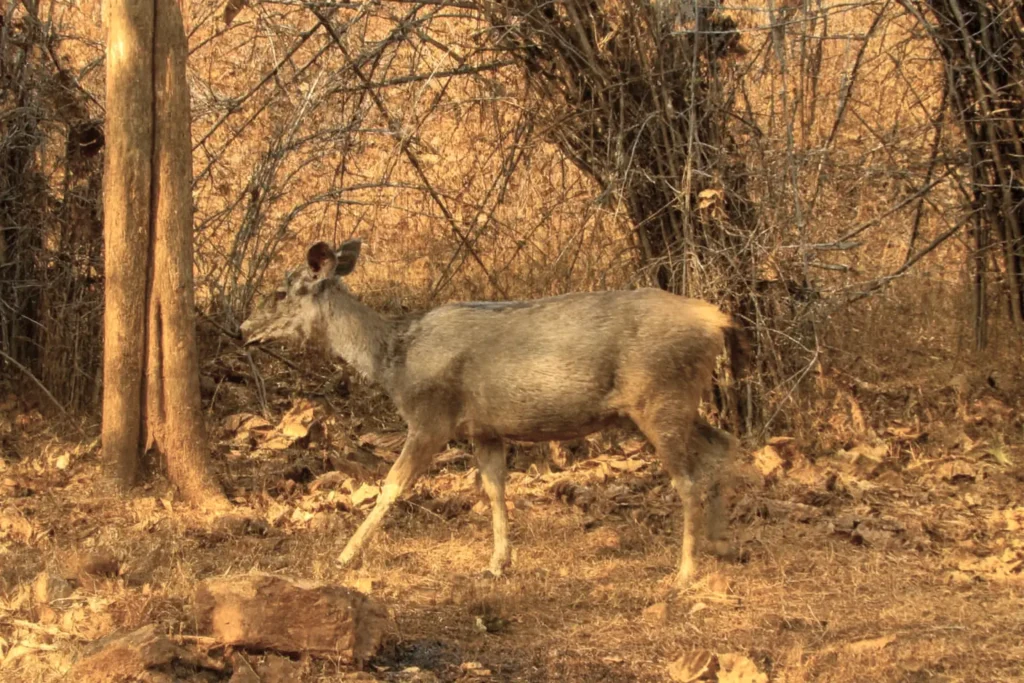
Nature has played the ultimate prank. The one colour the deer cannot truly see happens to be the colour of its greatest threat.
Colour, however, is only half the story.
Even the right shade of camouflage fails if the shape beneath it gives the game away. A solid block of colour, however dull, is still a recognisable silhouette. This is where the tiger’s stripes come into their own.
The Illusion Written in Stripes
The strategy even has a name and its disruptive coloration.
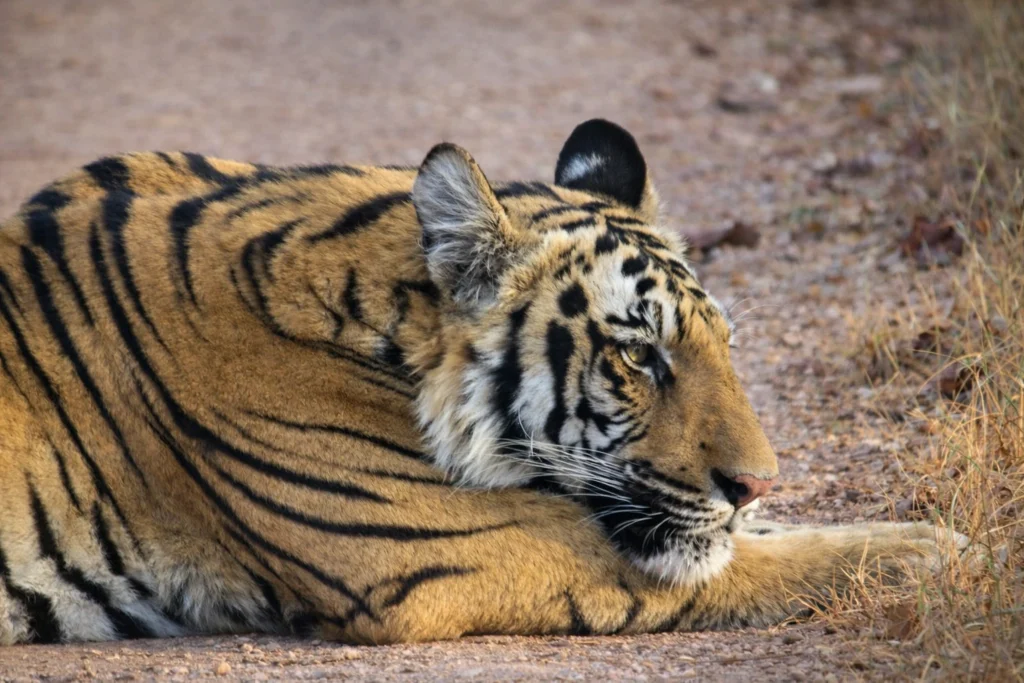
Those bold black stripes are not decoration. They are architecture. In a jungle where sunlight filters through the canopy in long shifting columns, the stripes mimic the vertical lines of bamboo and tall grass. They break up the body’s outline. They dissolve its shape.
When a tiger freezes, it does not merely hide.
It disappears.
The deer sees no animal. Only a confusing patchwork of light and shadow that looks, to its limited perception, like ordinary undergrowth.
A five-hundred-pound cat, rendered invisible by geometry, genetics and one wonderfully cheeky natural optical illusion.
There is still another question.
If green is such an obvious camouflage colour, why did the tiger never evolve green fur?
Why Tigers Never Turned Green
In theory, perhaps it should have.
In practice, mammals simply do not have the chemistry for it.
Birds and reptiles can produce green pigments. Mammals cannot. The mammalian colour palette contains precisely two pigments: eumelanin, which produces blacks and browns, and pheomelanin, which produces yellows and reds.
There is no green in the recipe book.
Evolution, practical as ever, simply worked with what it had. Orange was available. The tiger’s prey could not distinguish it from the surrounding vegetation. That was good enough.
And so the tiger emerged—not green, not invisible in the human sense, but perfectly hidden from the only eyes that truly mattered.
There is something quietly humbling in all of this.
The tiger’s survival is built upon a limitation in another creature’s vision. A single biological quirk in the deer’s eye tips the balance. If deer ever evolved the ability to distinguish red from green, the tiger would suddenly become a far less successful hunter. An entire predator-prey relationship, refined over millions of years, rests upon this one small accident of biology.
Nature’s Perfect Deception
It is a reminder that nothing in the wild exists in isolation.
Every advantage is borrowed from someone else’s disadvantage.
Every design is part of a conversation between hunter and hunted, stretching back further than we can imagine.
The deer might be justified if it ever complained about being tricked. It does seem rather unfair to be blind to the very colour of your greatest danger. But then, nature has a food chain to balance and sentiment rarely enters the equation.
The tiger knows none of this, of course. It simply crouches, waits, hunts and vanishes.
The deer, equally unaware, simply grazes—never knowing that the forest itself has concealed its greatest enemy.
And the forest, ancient and indifferent as ever, keeps its secrets.
As we drove back from the safari to rejoin friends whose conversations would soon drift back to old classrooms, old pranks and forgotten ambitions, I found myself thinking not about the tiger we had seen, but about the deception that had made the sighting possible.
Understanding the science transforms a tiger sighting. You are no longer watching just a predator. You are witnessing millions of years of evolution playing out silently before your eyes.
And somehow, the forest becomes even more magical than it was before.