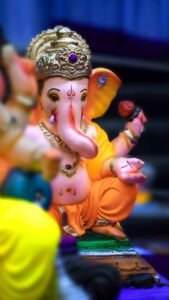

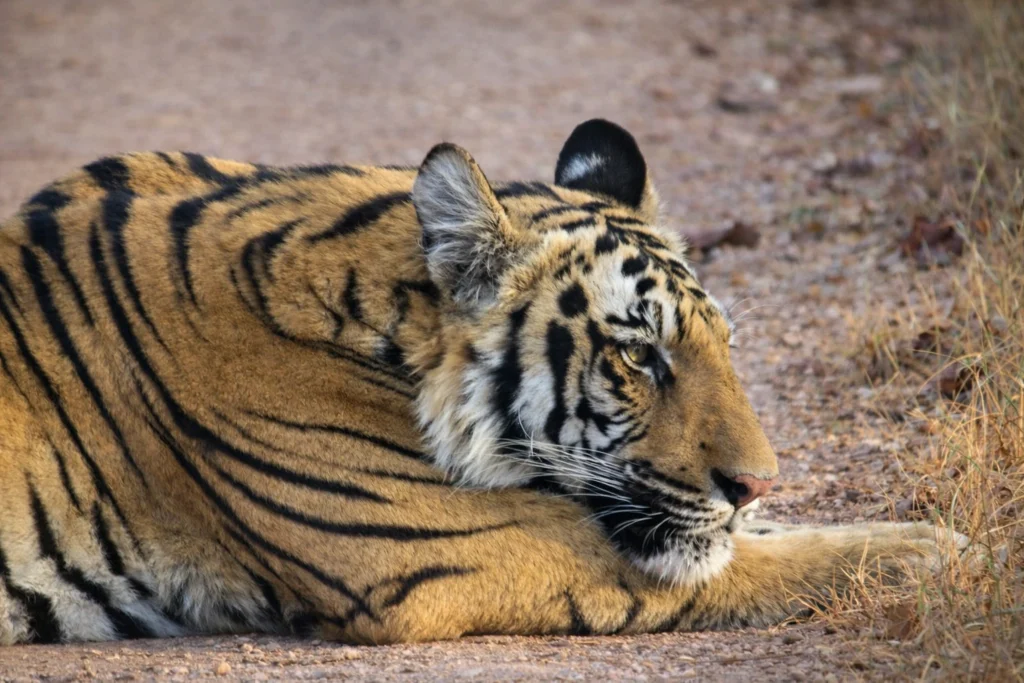
The Tadoba Tiger Reserve region has been a generous host. The resort, Pug Marks, sits next to one of the safari gates. This was the second day of our stay, the day reserved for the safari. It lived up to every expectation and became the icing on the cake of our college reunion.
I have been around these forests before. I was born in this region. But it had been some time since my last visit.
The previous evening had been a beautiful blur—songs, laughter and old stories. But the morning belonged to the forest.
We were up before the sun. By 5:30 a.m., our safari jeeps were waiting at the resort, engines idling in the darkness. Five to a jeep, we clambered in, still half asleep, as the convoy rolled towards the gates of the Tadoba Andhari Tiger Reserve.
Tadoba lies about 150 kilometres from Nagpur, deep in eastern Maharashtra. Spread across 625 square kilometres of deciduous forest—teak, bamboo and open grasslands—it was declared a national park in 1955 and remains one of India’s most reliable places to spot a wild tiger.
At the entrance, identity cards are checked and every visitor is handed a bottle of water. Then the jeeps move into the forest.
Into the Forest
The darkness was just beginning to lift as we rolled along the brown earthen tracks. Soon the dense canopy pressed close on either side, with narrow paths vanishing into the undergrowth—rangers’ trails, off-limits to visitors. Running parallel to the road were strips of burnt grass. These are the fire lines or firebreaks, created to stop a raging forest fire from spreading further.
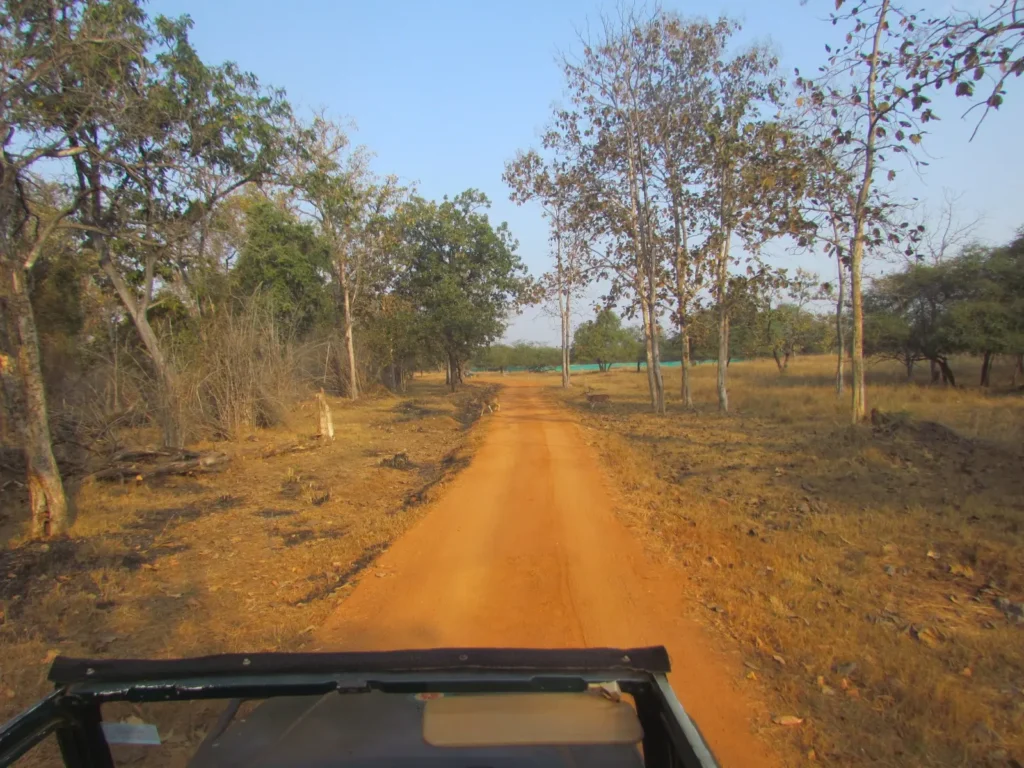
The cold was sharp and clean. The silence was the kind you feel in your chest: complete and alive, broken only by the fading call of a nightjar finishing its night shift and the sudden screech of a jungle fowl. Nothing like the familiar crow of a domestic rooster—this was almost a warning cry.
Our guide was a young man from the region. He spoke in that familiar Vidarbha blend of Marathi and Hindi that belongs entirely to Madhya Bharat—rough around the edges, richly local and completely sincere. He knew the forest well and was already guiding the driver towards the tiger’s likely haunts.
As daylight seeped in, the bamboo thickets came into view. They wore a strange ashen colour, and the guide explained why. These older plants were dying, their life cycle complete, making way for the bright yellow-green shoots pushing up from the roots below. There was something quietly moving about it—the old receding, the young surging upward, all of it unhurried and inevitable.
A Forest Awakens
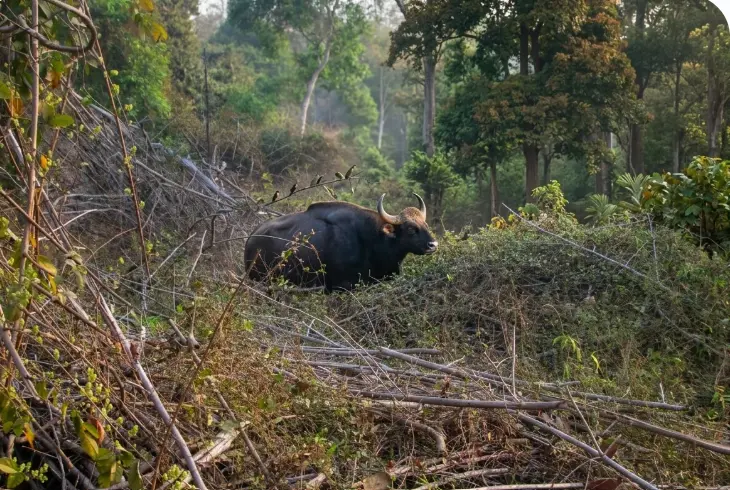
The jeep slowed for a gaur—an Indian bison—standing among the bushes, massive and unhurried, its curved horns catching the early light. It regarded us with calm authority, decided we were harmless, and returned to its breakfast.
Further along, sambar deer grazed in small groups, while a cluster of spotted chital gathered near a distant waterhole, their coats glowing against the dry earth.
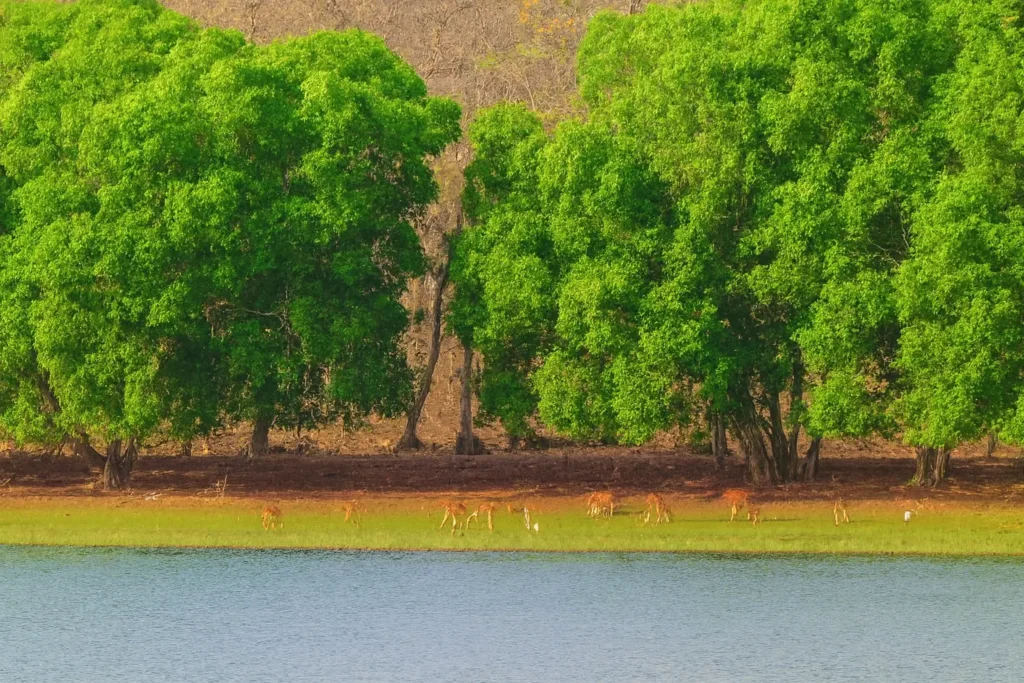
The reserve’s central lake appeared like a revelation in the morning mist. Evergreen jamun trees lined its banks, and behind them stood leafless trees, their bare branches crowded with birds conducting what felt like a noisy morning meeting. A peacock sat high in the canopy, surveying the proceedings from above.
The world felt very old here, and very much at peace.
The First Tiger
Then the jeep braked.
Ahead, a line of other vehicles stood motionless, their occupants all pointing in the same direction.
There he was.
A full-grown male tiger, moving through the dry grass with the unhurried confidence of something that has nothing to fear. The word majestic doesn’t quite do him justice. His movement was liquid—each step placed with a softness that seemed impossible for an animal of that size. The orange of his coat burned between the pale stalks of grass.
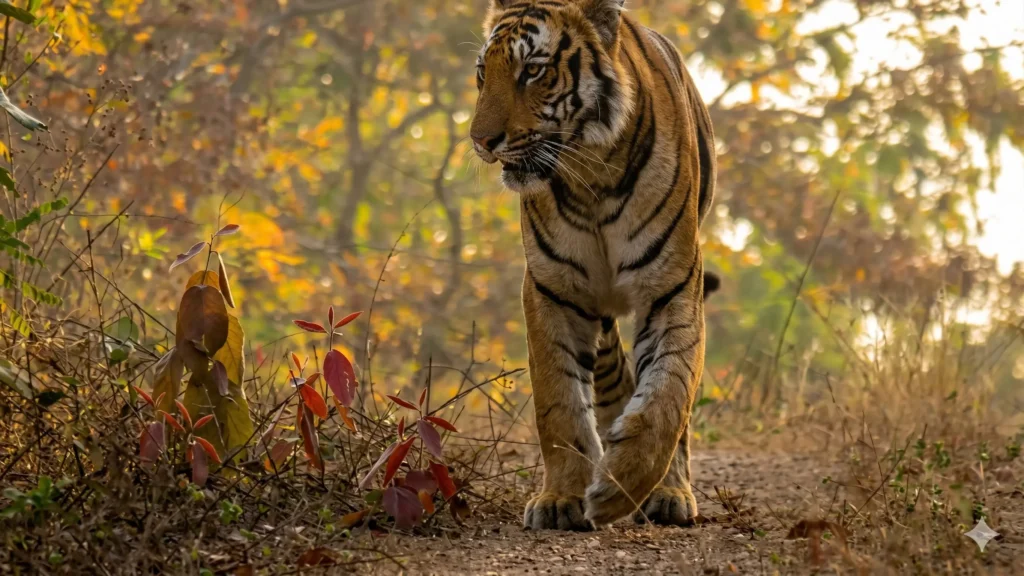
Interestingly, while that brilliant orange appears striking to us, it is almost invisible to a deer. It is a trick that nature plays to keep the balance intact through a stunning camouflage,. ( Read more : Why Tigers Are Orange )
We watched until he disappeared into the trees.
More Than We Could Have Hoped For
On the way back towards the gates, we thought we had seen everything worth seeing.
We were wrong.
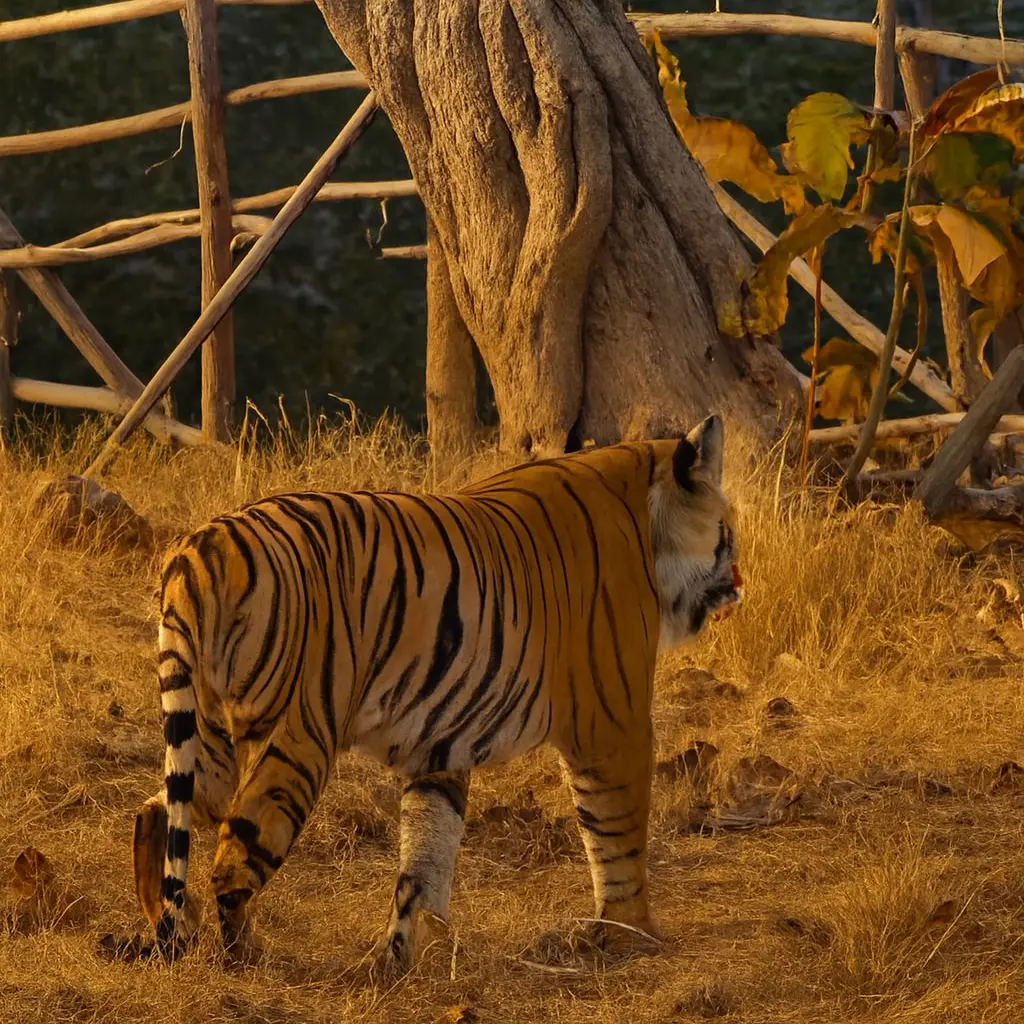
A second tiger lay submerged in a shallow pool, with only its shoulders above the water. As if sensing the occasion, it slowly waded out just as our jeep pulled up. Its full form emerged from the water, deliberate and unhurried. It shook itself, walked to a nearby tree, rose on its hind legs and dragged its claws slowly down the bark.
A predator marking its territory.
A reminder that we were only guests here.
As if that were not enough, fortune smiled once again.
A tigress emerged from the bushes just a few feet from our jeep. Oblivious to our presence, she walked calmly past us before disappearing once more into the undergrowth.
One could not have asked for more.
Three tiger sightings. Memories for a lifetime.
A Story for Another Day
Our guide pointed out several other curiosities along the route, including a pale, ghostly tree that locals simply call the Ghost Tree—a story for another time.
(Read here: The Ghost Tree)
What the Forest Leaves Behind
A morning in a forest like this does something to you.
The cold, the silence and the unhurried rhythms of life and death, playing out without any need for an audience, recalibrate something deep inside.
We have taken so much of this world for ourselves. What remains of the wild deserves every effort to survive and thrive.
Let us do more for it.
As we drove back through the gates, I realised this reunion had quietly become about far more than old friendships. It had also been about returning to the forests I grew up around, rediscovering the silence of nature and, as always, finding history waiting nearby.
At this stage of life, perhaps those are the three things that matter most—friends, the quiet of the wild, and the timeless stories that our temples and landscapes continue to tell.