How a champion cyclist hid forged identity papers in his bike frame during WWII, and kept it a secret until his death
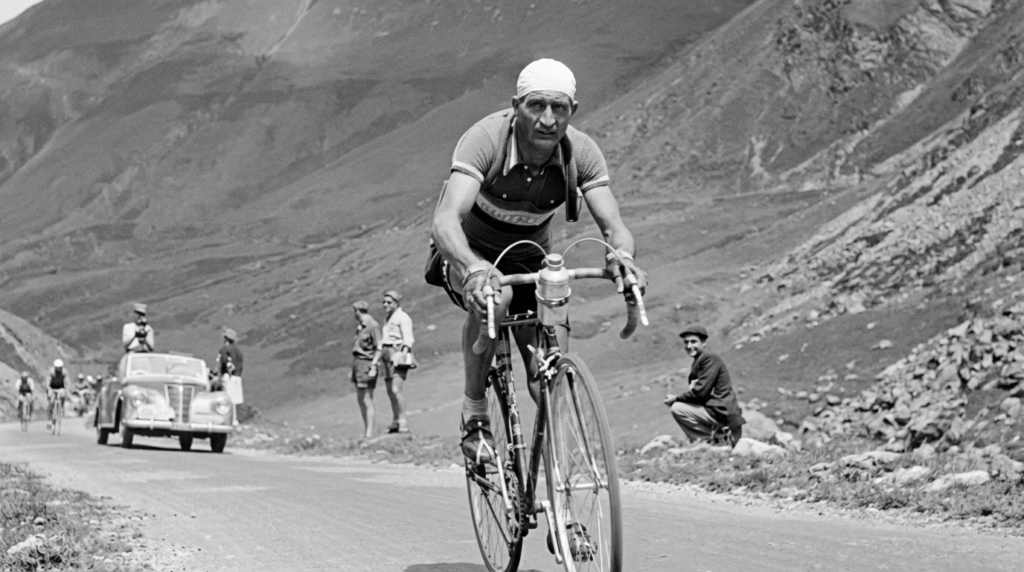
The World War II rages. Somewhere on the road between Florence and Assisi, a soldier raises his hand and a cyclist brakes. Hidden in the frame of the bicycle are forged identity papers, each one the difference between escape and deportation for a person Gino Bartali will never meet. The soldier recognizes the face. Everyone in Italy knows that face. Bartali asks him not to touch the bike, saying it has been carefully calibrated for speed. The soldier steps back, and the champion pedals on.
Nobody on that road knew what they had just waved through. For more than fifty years, hardly anyone would.
Gino Bartali is considered among the greatest cyclists in history. While almost all knew the cycling stories, there was something else about Bartali that stayed unknown for years.
Bartali was born in 1914 in Ponte a Ema, a small town near Florence. He and his brother would cycle up the serpentine roads that lead to the magnificent Piazzale Michelangelo. The square is a social landmark of Florence, a place to admire the beauty of the the city as it stretched out into the distance. He dreamt of being a cyclist while riding up and about the hill and the city.
He chased his cycling dreams into the professional ranks in 1935. The world took notice the very next year, when he claimed the Giro d’Italia, Italy’s crown jewel of the peloton. It was also the year his brother Giulio, a racer too, died after a crash during a race. Bartali is said to have considered quitting. Instead he raced on, and victory came calling again in 1937.
Now a star, he conquered the grueling Tour de France in 1938. The 1939 edition drew sparse fields, with Italy and Spain absent amid rising political tensions, a grim harbinger of World War II’s shadow.
Epic 1948 Tour de France Victory: A Nation’s Distraction
The Tour was not held from 1940 to 1946. It resumed in 1947, and in 1948, ten years after his first win, Bartali won again in the Alps of south-eastern France.
The Tour de France win in 1948 was not just another win. In a strange sense, it had a profound social impact. It was a win that distracted the Italians from the dark events that were unfolding.
Italy was just finding political stability after the war, but things turned sour unexpectedly. Palmiro Togliatti, the leader of the Italian Communist Party, was shot three times outside the parliament building in Rome, and Italy descended into unrest. Protests erupted, violence broke out, and revolution was in the air.
Bartali was riding the Tour de France and its mountain stages. Worried about his family, he contemplated returning. He is said to have received a call from the Italian Prime Minister, Alcide De Gasperi. The message De Gasperi conveyed was simple. The Tour had to be won; Italy needed a distraction. Bartali later recounted his reply:
‘I can’t promise you that I will win the Tour because the Tour is won by arriving in Paris in yellow. I guarantee you the stage… I will make it beautiful.’
Bartali was trailing the yellow jersey holder, Louison Bobet, by about 21 minutes (which is a lifetime in the Tour de France). The next stage was in the scenic but tough Alps, over the Col d’Allos. In freezing rain Bartali left his opponents behind with a stunning attacking ride. The effort cut his deficit to just over a minute.
Bartali had gained almost 20 minutes in one single stage, and he was not done.
The next stage saw him win again, and this time he took the yellow jersey. At 34, with aging and aching legs, he still had enough strength to hold off the younger men. It was an effort that bordered on the impossible.
Bartali’s efforts over the mountains had given the Italians something to celebrate. As Bartali later explained, ‘In Parliament there were those who shouted, “Bartali is the yellow jersey! Long live Italy!”’
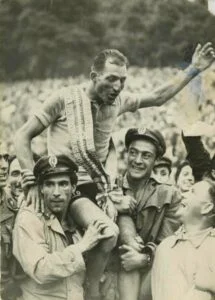
Gino Bartali went on to win the Tour de France by 26 minutes. He had done his bit for the country. He retired a few years later, in 1954, at the age of 40. He kept a very low profile after retirement. He died peacefully in 2000.
The newspapers across the world penned the obituary of a champion cyclist. His exploits on the mountains of the Giro D’Italia and Tour de France were recalled with reverence. A great sportsman had passed into history, and the news, like all news, faded away.
How Gino Bartali Saved Jewish Lives in WWII.
But then as time rolled by, it became clear that there was another story that was hidden away.
A story that was all about the real Gino.
The story emerged in pieces, a bit here and a bit there. What emerged was a story that is a tribute to Bartali’s inner self.
As the World War was raging, hatred was showing itself in many forms. After Italy’s armistice in 1943, German forces occupied the north and the center of the country, and Mussolini, who had ruled Italy for two decades, now headed a German-backed regime. Political refugees were being hunted down, and Jews were being rounded up and deported to the death camps.
It was during these times that the real Bartali emerged. A devout Catholic, he was called over by the Archbishop of Florence, Cardinal Dalla Costa, who convinced him to be a part of a network. A network that would print and move fake identities to Jews to enable them to escape being identified. Using his cover as a champion cyclist on his practice runs, he worked as a bike messenger. He cycled thousands of kilometers across Tuscany, Umbria and the surrounding region, often on long runs between Florence and Assisi, delivering the identities and money to hundreds of Jewish and other political refugees.
The Germans and the fascist militia monitoring the roads would not stop a champion racer who was supposedly on his practice runs. It was the same road, and the same scene, many times over. It was as risky as anything, but then Bartali went on with his rides. In 1944 he was arrested and interrogated by the fascist police, but he still kept the network’s secrets.
Bartali hid the documents in the frame and handlebars of his bike, carrying them from a secret printing press to families across Italy and enabling them to escape their fate. He is credited with saving the lives of at least 800 people, though that figure is an estimate.
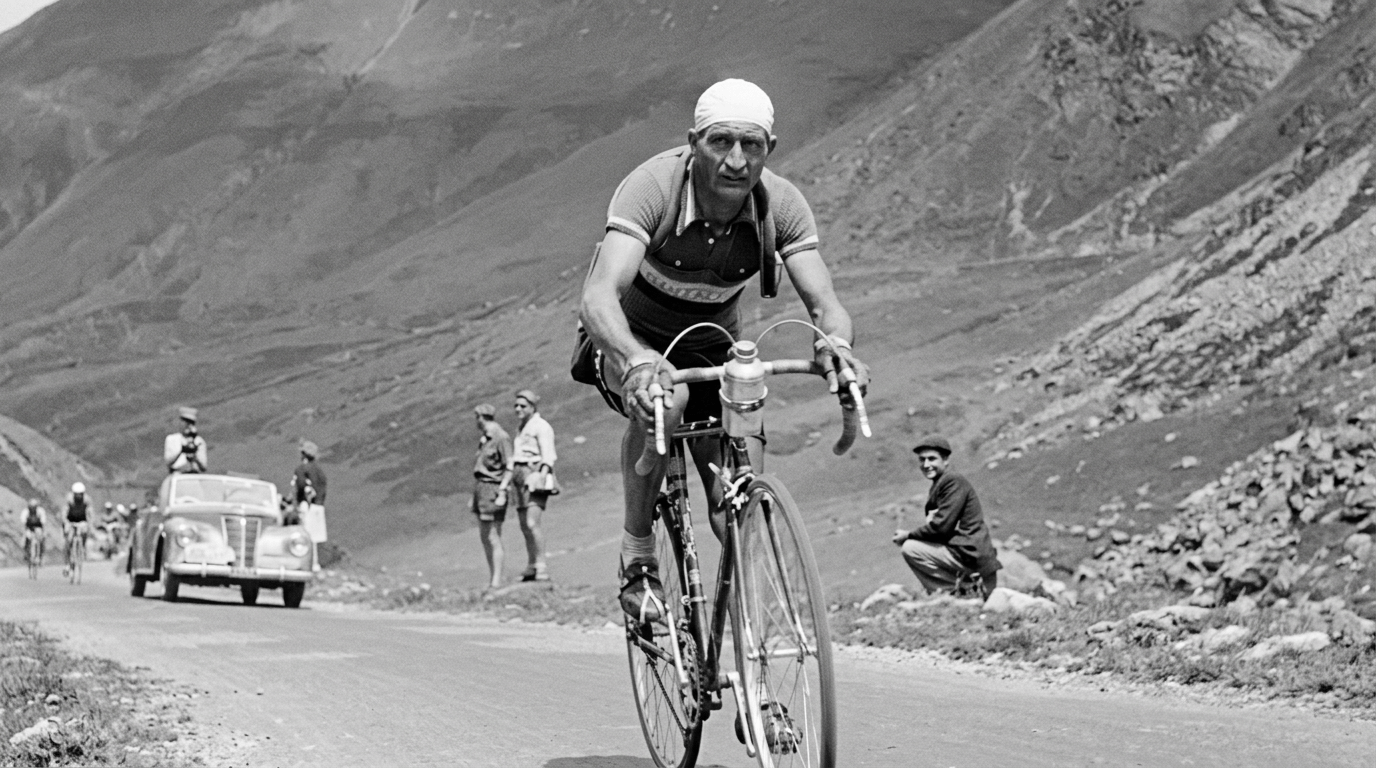
After his death in 2000, as accounts from people who were saved by his actions came to light, the Bartali legend transformed. In 2013, Yad Vashem the World Holocaust Remembrance Center in Jerusalem, recognized him as Righteous Among the Nations. ( a tribute to those who saved Jewish lives while risking theirs)
He was not just a champion cyclist but also a man who risked his life and his reputation to save lives, hundreds at that. The unassuming champion was adamant that it remained a secret. No one had any idea of the risks he was taking.
In his own words on why it was never told, he is said to have explained it to his son.
If you’re good at a sport, they attach the medals to your shirt and then they shine in some museum. That which is earned by doing good deeds is attached to the soul and shines elsewhere.
Gino Bartali was a champion cyclist, but then he was also a champion in something that the world lacked yesterday and lacks today. Compassion and the willingness to help those in trouble.
Grazie, Gino.
==============================================================