

Few countries ask a visitor to look beyond geography, but India does it every minute. It wears its past as comfortably as its modernity. Sparkling skylines rise in the big cities, yet history, tradition and faith are never far away.
It is hard to travel far in India without encountering a place of worship. A dusty village road may end at a temple that has stood for a thousand years. A narrow mountain path may lead to a shrine where villagers will tell you the gods once lived.
Faith is woven into everyday life. Before dawn, jasmine and incense mingle in the flower markets. Shopkeepers light a small oil lamp before their gods, even before the first customer arrives. The gods may be different, but the ritual is much the same.
Drivers slow down at roadside shrines to offer a silent prayer without leaving their seats. These small acts rarely make it into photographs, but they tell us much about India’s religious life.
The Land Was the First Shrine
Long before the first temple tower rose above the plains, people had already marked places as sacred: rivers, mountains, caves, groves and solitary rocks. Some needed no building at all. The landscape itself was enough.
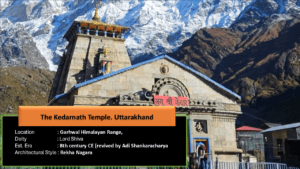
The Himalayas hold a special place in India’s religious imagination. Mount Kailash, in Tibet, is regarded as the abode of Shiva and is sacred to Buddhists, Jains and followers of Bon as well. The Chota Char Dham pilgrimage to Kedarnath, Badrinath, Gangotri and Yamunotri leads through deep valleys and forests of pine and deodar. The journey is often as much a search for God as it is a physical challenge.
The walk to Kedarnath alone is roughly 16 km of steady climbing. The pilgrimage becomes an experience long before the temple comes into view.
In Kumaon, divinity envelops the hills. Among the cedars around Jageshwar, time seems to stand still. It was one of those temples that drew me in and never left my memories. Nothing there is in a hurry. Time slows down as one breathes in the cool mountain air.
Chitai Golu Devta, near Almora, is dedicated to one of Kumaon’s most revered local deities. Thousands of bells hang from every available space. Many have been offered by people seeking justice from the local deity, while handwritten petitions hang beside them. It is more than a place of worship; it is where people come seeking justice from their deity. [ Read here Chitai Golu Devta and Jageshwar, Kumaon]

If the mountains inspired reverence, the rivers sustained civilisation. The Ganga’s descent from heaven is among Hinduism’s enduring legends; the Yamuna is closely associated with Krishna, and the Godavari is often called the Ganga of the south.
The Narmada Parikrama, a journey of roughly 2,600 km along one bank and back along the other, makes the river itself the destination. Further south, the Kaveri shaped the temple civilisation of the Cholas, and many of Tamil Nadu’s great temples stand along its banks.
Forests, too, have always held a special place in India’s spiritual imagination. The Aranyakas and several Upanishads are associated with the tradition of forest learning and contemplation. The Ramayana and Mahabharata return repeatedly to the wilderness.
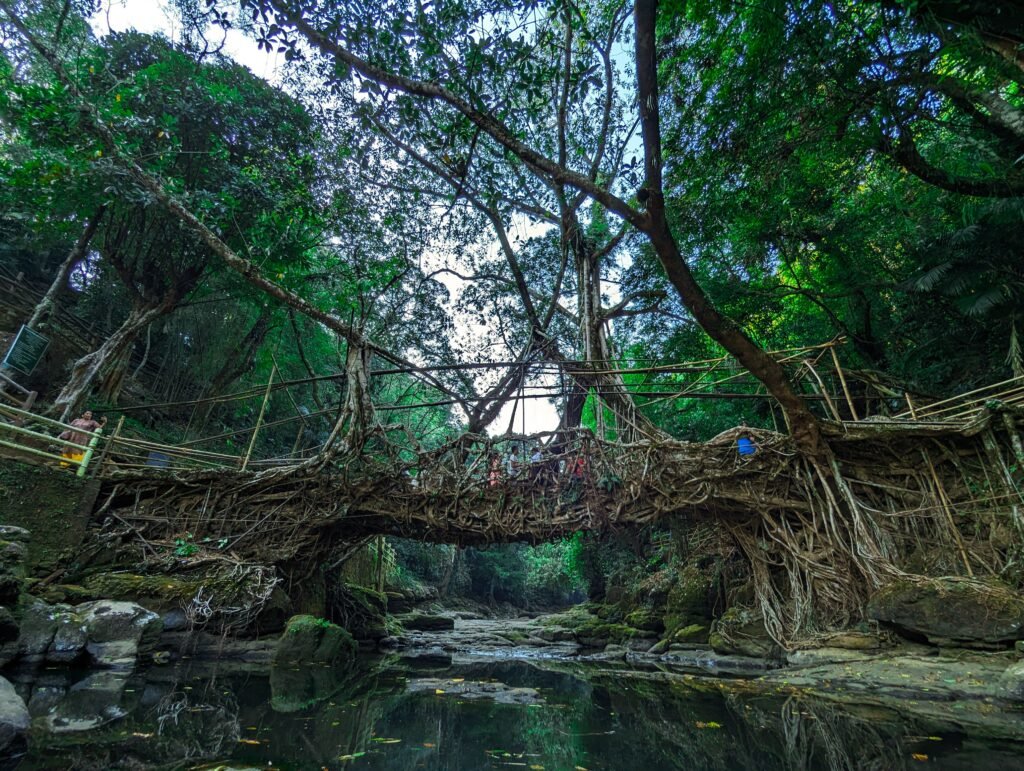
That relationship between nature and faith survives in sacred groves, known as kavu in Kerala, devarakadu in Karnataka and oran in Rajasthan. In Meghalaya, the Khasi people protect groves such as Mawphlang, where tradition forbids even the removal of a fallen branch. Long before conservation became a formal concern, belief helped protect these forests.
A Civilisation Measured in Pilgrimages
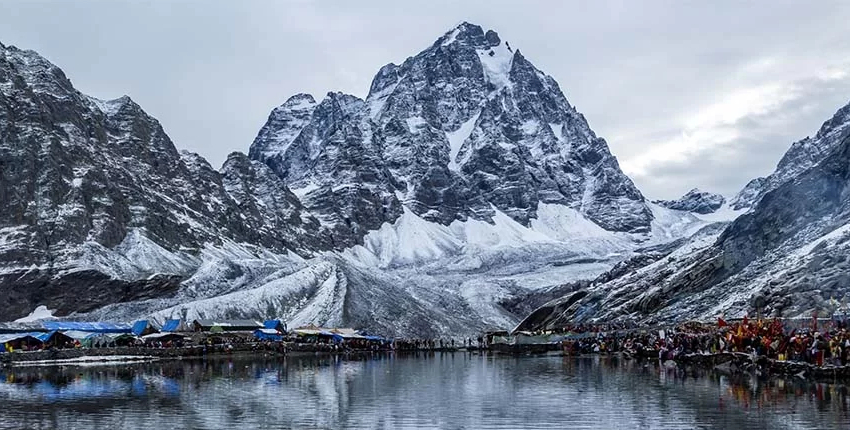
India’s history can be read through its pilgrim routes as well as its dynasties. Long before highways, pilgrims crossed the subcontinent on foot, over mountain passes, through forests and across rivers. For many, the effort itself was part of the offering: the climb to Sabarimala in Kerala, the demanding journey to Manimahesh Lake or the long trek to Kedarnath.
Along these routes, towns grew and markets sprang up. People from distant regions prayed side by side, and some stayed on, becoming part of local society. Pilgrims carried ideas, music, customs and stories with them, helping shape what we now call Indian civilisation.
Many of these routes are still walked today. The journeys may have become easier in some places, but the faith that draws people to them has endured.
The Temple: More Than Stone
Walk into an Indian temple and there is a great deal to take in : towering gateways, sculpted walls, pillared halls and courtyards full of devotees carrying flowers and coconuts. Somewhere inside, a priest chants while the nadaswaram, conch or shehnai sounds out.
A devotee sees the home of a God; a historian sees the ambitions of a king; an art historian sees the work of generations of sculptors. All of these can be true within a single building.
At the heart of the temple lies the garbhagriha, the “womb chamber”, where the principal deity is installed. After the scale of the entrance, it can be surprisingly small: dark, enclosed and lit largely by lamps. Its design evokes the idea of the cosmic womb.
Look closely at the carvings. Dancers appear mid-gesture, musicians hold their instruments, and the walls preserve details of clothing, dance and everyday life. The stonework is not merely decoration. It tells stories of gods, kings, beliefs and the society that created it.
The great temples of the south often resemble fortified towns. Within their walls are shrines, kitchens, wells, tanks, gardens and halls for music and dance. Markets and settlements grew around them. Kings held ceremonies and led festival celebrations. Temples also hosted scholars debating philosophy and musicians composing and performing classical music.
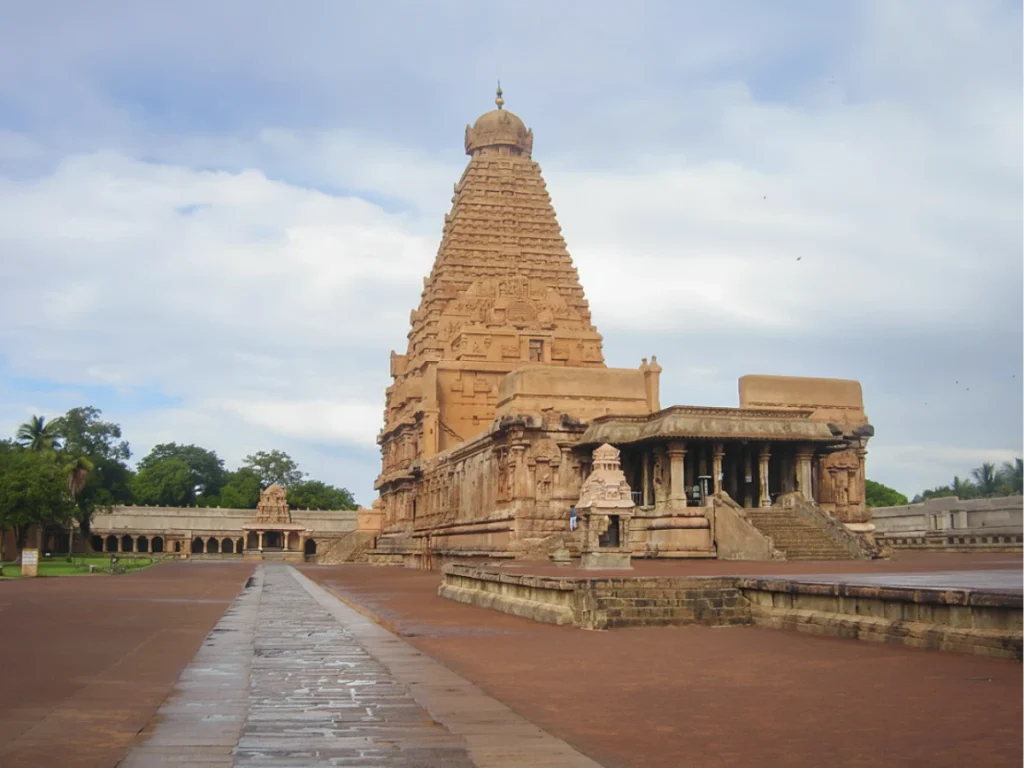
At Thanjavur, the Brihadeeswarar Temple, completed under Raja Raja Chola I around 1010 CE, still dominates the landscape with its magnificent vimana. Its inscriptions record gifts, accounts and the names of musicians and dancers, offering a remarkably detailed picture of Chola administration and culture. [ Read here Brihadeeswarar, Thanjavur]
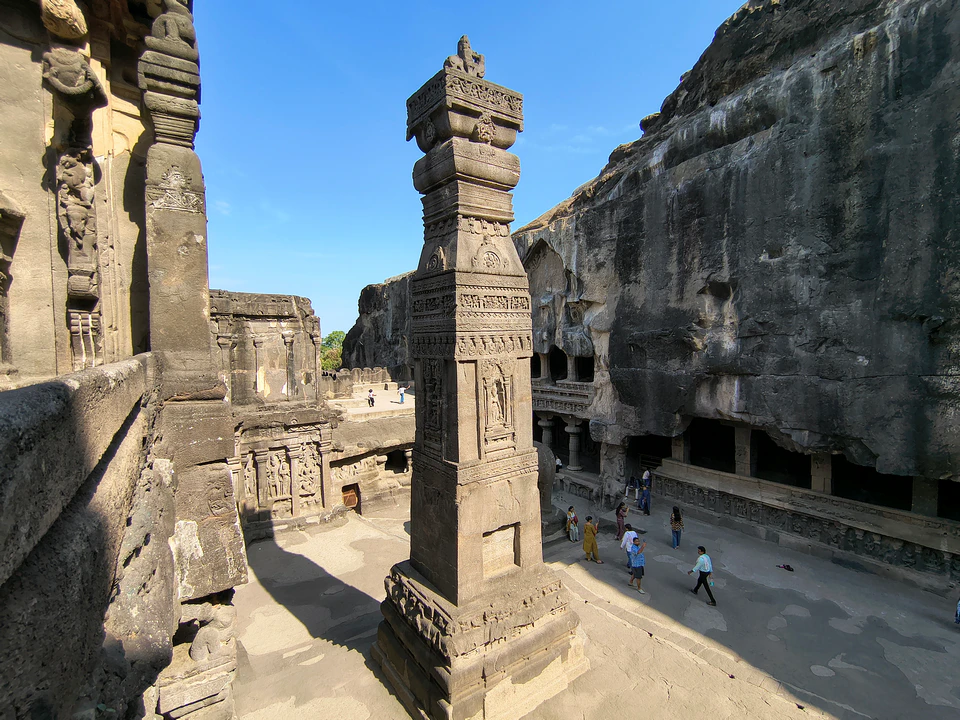
The Kailasa Temple at Ellora is a different kind of marvel. Built under the Rashtrakutas in the eighth century, it was carved out of a single rock outcrop, cut downwards from the top. Courtyards, pillars and sculptures had to be planned before the first stone was removed. There was little room to correct a mistake. To me, it is one of the greatest works of architecture in the world. The scale and the complexity have to be seen to be believed. [ Read here Kailasa, Ellora]
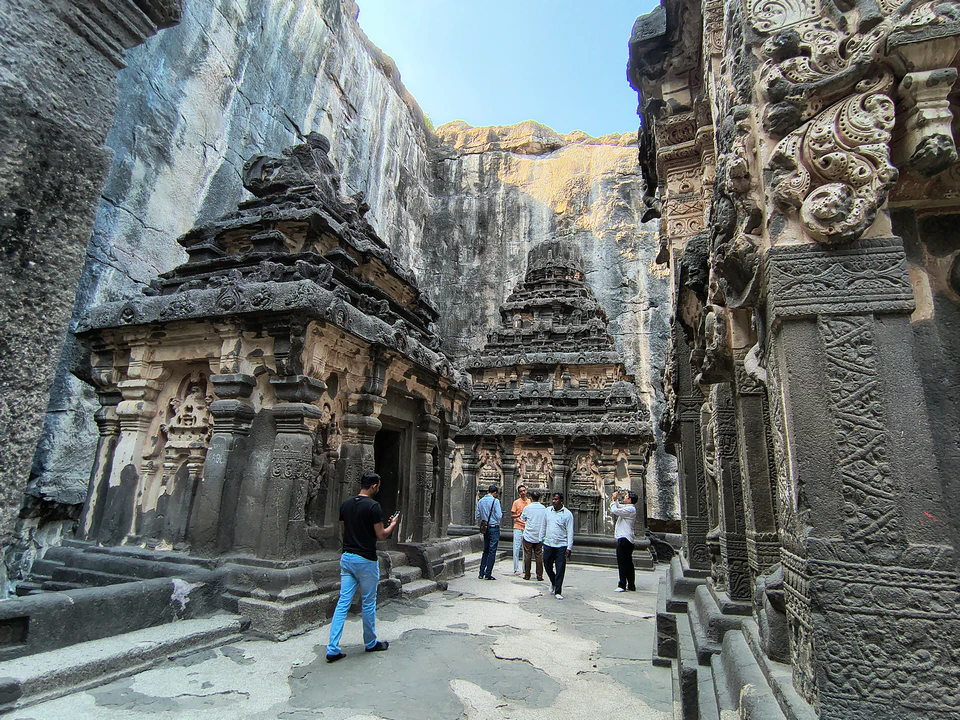
Temples like these are also archives. Their inscriptions and sculptures preserve evidence of dynasties long gone and local traditions that have survived changes in power.
Living and Silent Monuments
It would be too neat to suggest that every Indian temple is alive.
Konark has not been a functioning place of worship for centuries.
Most of Hampi’s great Vijayanagara monuments stand silent, yet the Virupaksha Temple at its heart continues to host daily rituals and festivals. The ruins stand in stark contrast, reminders of the relentless passage of time. ( Read here Hampi : A Grim Reminder)
At Khajuraho, the Matangeshwar Temple remains an active shrine, while the better-known groups around it are protected monuments.
Often, you can see both at once: stone that has become history and stone that is still being prayed to. That difference is worth looking for. One belongs largely to the past; the other continues to be part of everyday life.
The People Who Keep the Temple
A temple is sustained by people most visitors never notice: florists threading garlands before dawn, priests dressing the deity, cooks preparing offerings, sculptors maintaining the carvings and lamp makers working around the gates.
At aarti, a priest waves lamps while bells ring and chanting rises around him. The prasad that follows is not merely received; it is eaten and shared. Think of Tirupati’s famous laddu or the Mahaprasad of the Jagannath Temple at Puri, cooked in earthen pots.
These details are easy to miss when we look only at the stone. Yet they are what make a temple a living institution.
Festivals and the Rhythm of the Year
A temple on an ordinary morning is one thing; during a festival, it becomes something else.
At Puri, the Rath Yatra sends three enormous wooden chariots down the Grand Road, pulled by thousands of devotees.
Down south, Thrissur Pooram transforms the town into a riot of colour and sound. Decorated elephants, the spectacular kudamattam ( the ceremonial exchange of brilliantly coloured umbrellas) lead into an evening of fireworks. It is one of Kerala’s most anticipated festivals.
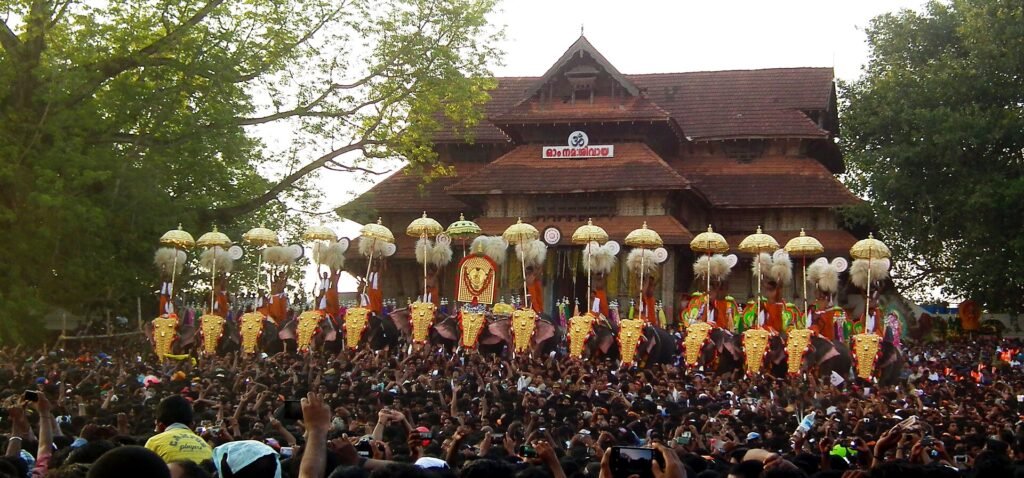
At Tiruvannamalai, a great flame is lit on the hilltop during Karthigai Deepam. The Kumbh Mela, held in rotation at Prayagraj, Haridwar, Ujjain and Nashik, is among the largest religious gatherings on earth.
Even the smallest temple in the sleepiest village comes alive when the oil lamps are lit in the evening.
These festivals are not simply spectacles for visitors. They are expressions of faith, community and tradition, often repeated over centuries. For a few days, an otherwise familiar town can become almost unrecognisable.
Why This Journey Matters
Over the years, I have travelled through many corners of India in search of stories, from monuments known around the world to village shrines where visitors are few. What stays with me is not always the grandest building. Sometimes it is a conversation with someone who has visited the same shrine for decades, or a petition hanging among thousands of bells at Chitai. Often, it is the fascinating myths that people tell.
A thousand-year-old temple can feel both ancient and familiar. Its architecture belongs to another age, while the lamps, flowers and people who gather there tie it firmly to the present.
No single temple can explain this India. Each has its own history and its own relationship with the land around it. The articles in the Timeless India explore what these places, their histories and their stories have meant to me.
They are about understanding how these places came to be built, what they meant to the people who built them, and why generations keep returning.
Perhaps that is the best way to understand this facet of India. Not by counting the temples one has visited, but by listening to the stories that have kept them alive.
These stories, etched in stone, whispered in prayers and carried across generations, turn a journey across the land into a journey through time.

Amazing and well researched article written in a spectacular style by author. Please keep enlightening us with the fascinating ancient architecture which made us believe that generations before us who built these monuments were far more intelligent and far sighted then we are now.