

In the 1960s, a historian of science, Derek J. de Solla Price, formulated a theory while studying a database of academic papers submitted by scholars. The law is famously known as the square root law.
If you are expecting me to explain Price’s Law in detail, I am sorry to disappoint you. Instead, I will take you along as we delve into our work life and see it in action. Theory can be boring, and I don’t do boring.
To the uninitiated, Price’s Law is a mischievous little theorem that says in any body of work involving a team, fifty percent of the work is done by the square root of the number of people .
As an example, in a team of 100, 50% of the work will be done by 10 people, while the other 90 will shape the landscape, move a few fingers, and perfect the art of looking busy.
The law is a cruel mathematical punchline that, unfortunately, often proves true and always lands.
The office is a jungle: a few lions do the hunting and ensure food is on the table. The rest perfect the art of looking busy. The law is a brutal, twisted version of Darwinian theory applied to the corporate world—survival of the busiest, not the fittest.
It is not that the 10% are always heroes. They are prisoners shackled by chains they willingly buy themselves. They are simply built differently.
They are the ones who keep the organization breathing, while others discuss which baker should bake the next birthday cake.
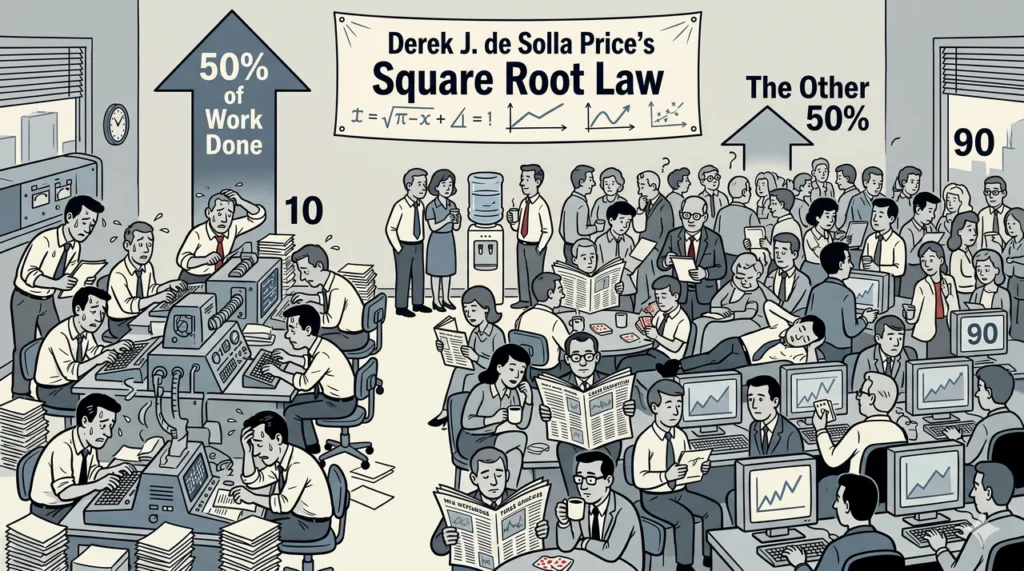
What do we do about the 90%? Are they just cost? No, they are not. They still contribute the other 50% of the work. They’re not just decorative plants with email addresses.
They may be a statistic, but not totally irrelevant.
The satire writes itself: corporations spend millions on “employee engagement” programs, team adventure camps, and family days.
Price’s Law captures an HR policy that HR itself has no idea about, because HR is also a symptom of this law. They can’t see through the lying resume. They don’t have a yardstick for attitude or intent of the people they need. The manager does not know he wants. The selection is a raffle, you lose almost every time and hope you might win once. Develop a smarter way of choosing people.
Hire as much as you want, but remember the law says half the work will always be done by the square root, while the many will stay busy updating their LinkedIn posts about how they are “learning” and how their bosses (duly hashtagged) are their guiding lights.
However, there is more to Price’s Law than that – It is about cost.
Value is a not in what you pay the employee, value is what your return on investment is.
The law is mathematical in nature and hence mercilessly compounds. The bigger the organization, the more dramatic the imbalance. A thousand employees? Thirty-two do half the work. Ten thousand? Just a hundred.
And yet, we cling to the illusion of teamwork. We plaster posters on office walls: “Together Everyone Achieves More” or “Let’s move the world”. We give away plaques for achievements that sound valuable but are a well dressed up farce. A award for something that never happened, one of that piece of work that failed a few months after the award was given, and one beacuse you thought the the guy had checked the “disagree” box in the internal survey.
Price’s Law laughs silently. It can see through you. The joke is on you. It tells you collaboration is often just a polite word for freeloading.
So what’s the solution?
Fire the 90%?
Tempting, but then who would fill the meeting rooms, schedule the “alignment calls,” and keep the coffee machine humming?
The truth is, the non-square-root majority serve a vital purpose: they make the organisation look like a bustling hive, when in reality a handful of people do all the work.
Without them, the illusion collapses, and shareholders might notice that the emperor has no clothes. With them they may blame the tailor.
Price’s Law is not just math; it’s satire disguised as science. It tells us that work is not evenly distributed, that effort is not democratic, and that corporate life is essentially a game where most contestants are extras.
The square root workers fight, bleed, and occasionally win, while the rest cheer from the sidelines, armed with motivational quotes, tea parties, and expense reports from exotic team-building trips.
So next time you’re in a meeting, look around. Statistically, only a few of you matter. The rest are ornamental — like potted plants in a busy corridor. Price’s Law doesn’t care about your feelings—it cares about your output. And if you’re not part of the square root, don’t worry. You’re still essential. After all, someone has to clap when the work gets done. Some are also needed to take the credit .
If you really care, then do something to be part of the square root. If more are willing to try and get into the square root bracket, the law by simple mathematics will collapse, and Derek Price would have egg on his face.
And your organization will be in great shape. You will have a happy team, and you might even have parties and camps that actually feel like parties and camps.