
This is a personal tribute and memoir of watching the legendary Ustad Zakir Hussain perform and meeting him in person.
It was a crisp evening in Pune in the mid-1990s. Winter had arrived in full force. The air was cold and nippy, and woolens were out.
The 1990s were a defining decade. Art remained untainted by modern reinterpretations, and music was still pure, blissfully unaware of the impending storm of remixes and experimental distortions.
It was a different musical age. Classical concerts still drew audiences willing to sit cross-legged through long performances, listening with patience and reverence. The Sawai Gandharva Festival represented that world at its finest.
A Winter Evening at Sawai Gandharva Festival
For generations, the Sawai Gandharva Music Festival has been a pilgrimage for lovers of Hindustani classical music. Legends have performed here, careers have been launched here, and unforgettable evenings have become part of Indian musical history.
I was at the Sawai Gandharva Music Festival, an iconic event held annually in Pune since 1953. It was a celebration of classical music at its finest, where both legendary performers and emerging talents showcased their mastery. The audience was always knowledgeable and discerning.
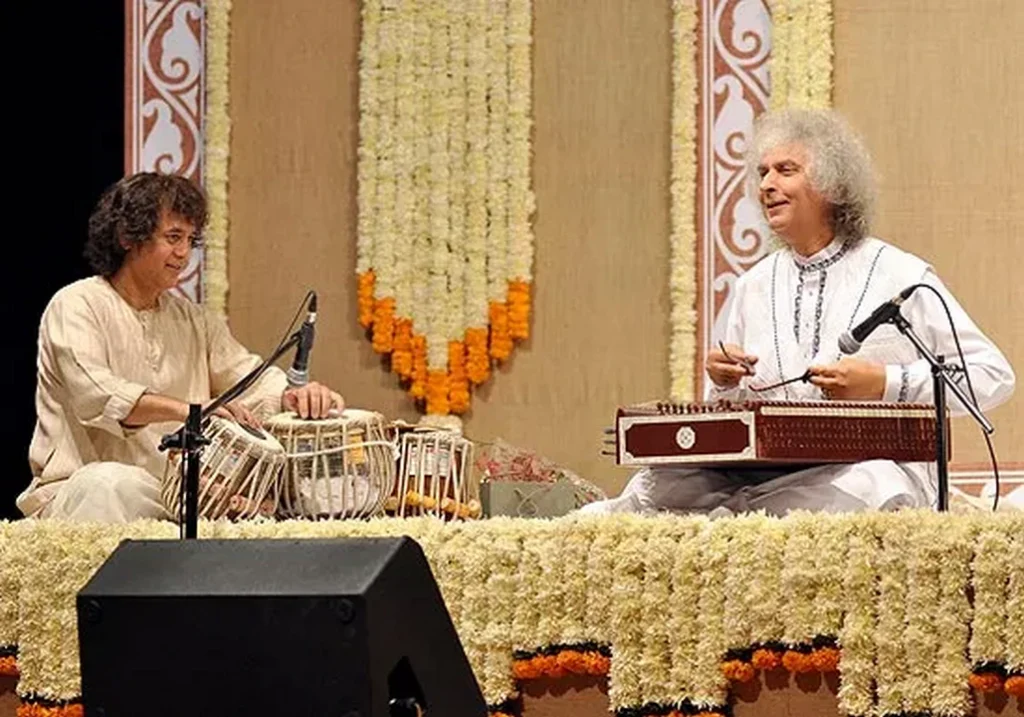
The grounds were already crowded. Grey haired women wore graceful draped shawls. Men had woolen sweaters and everyone waited for the moment. The stage stood at a distance, and people sat patiently on the floor, awaiting the next performance—an eagerly anticipated recital by Pandit Shiv Kumar Sharma, the unparalleled master of the Santoor. He was synonymous with the instrument, a true legend. Dressed immaculately in a bright kurta, he tuned the strings. Accompanying him on the tabla was Ustad Zakir Hussain, clad in a simple white kurta, his unruly, springing curls framing a charming smile.
When Two Legends Shared One Stage
For the next hour, we were transported into a mesmerizing world. The sharp tones of the Santoor intertwined perfectly with the tabla’s rhythm, creating an unforgettable experience. Slow ragas emerged languidly from the Santoor, followed by lively, playful pieces as the curved mezrab danced gleefully upon the strings. The tabla followed reverently, keeping pace with the masterful performance.
It was impossible not to be captivated by Zakir Hussain. His fingers moved fervently over the tabla, his mop of hair swaying like a barometer of the raga’s intensity. His head was never still, lost in the performance. The jugalbandi between him and Pandit Sharma was nothing short of magical—an unspoken dialogue through their instruments..
One led, the other followed. The elderly Pandit tilted his head in measured guidance, while the exuberant Ustad responded with a flick of his curly locks. It was an enthralling performance, etched forever in memory. I left elated, having witnessed two legends up close, only a few hundred feet from the action. Music is always one that evokes memories.
I already had a memory etched in my mind , one of the great Seerkazi Govindarajan ( Read here}
But then I never knew it was going to get better.
The Smile I Never Forgot
The following day, I had to travel to Madras (now Chennai) for an urgent business meeting. Though I usually traveled by train, this time I was permitted to fly. Arriving at the airport early in the morning, I found the air still nippy, cold even within the terminal. Seeking warmth, I settled onto a couch, my woolens doing their job as I immersed myself in a book.
Minutes later, the sound of footsteps made me look up. Across from me, dressed in white once again, stood Ustad Zakir Hussain—this time, just a few feet away.
I remember wondering whether I should walk across and thank him for the previous evening. But there are moments when admiration is best left undisturbed. I stayed where I was, content simply to share the silence and the prescence.
He wore the whitest kurta imaginable, paired with leather Kolhapuri chappals. He sank into the couch opposite mine, his eyes meeting mine as he nodded and smiled—a moment I have never forgotten.
That smile was electric. His lips curled, his eyes sparkled. It was as if an inner light had suddenly switched on. To this day, I have never seen a smile as radiant as his. I remained there for a few minutes before my flight was announced. As I stood and slung my bag across my shoulders, he looked up once more, flashed another of those dazzling smiles, and waved casually. I nodded back and walked away—from the warmth of a legend to the somber presence of my fellow passengers. Not a word was exchanged, yet I felt warm and content.
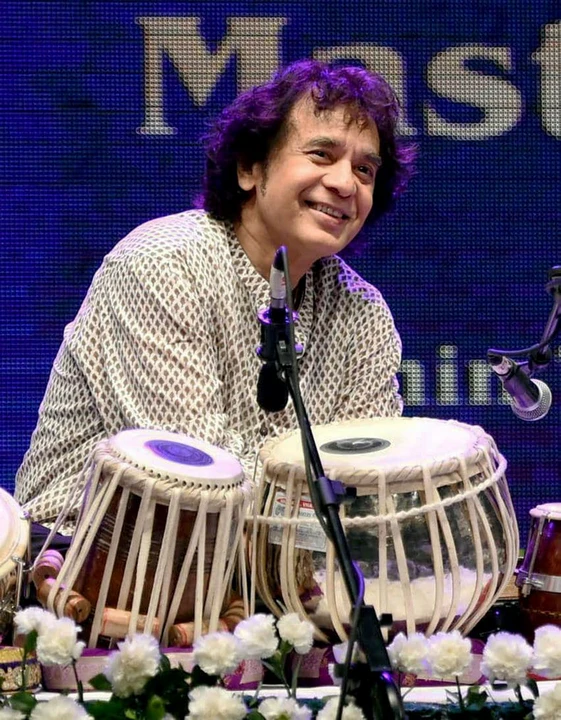
Ustad Zakir Hussain went on to achieve even greater heights. He grew into one of the towering figures of world music, spreading joy wherever he went. His jugalbandi with Pandit Shiv Kumar Sharma remains a treasured chapter in Indian classical music. He even made his mark in popular culture, appearing in the now-iconic Taj Tea advertisement. His achievements rivaled, if not surpassed those of his equally legendary father, Ustad Allah Rakha.
Ustad Zakir Hussain : A memory to cherish
To the world, he was an exuberant, immensely talented genius who became a legend.
To me, he was the only person I had met who, with his smile and twinkling eyes, could turn a cold winter morning into a cherished memory.
The Ustad is no more. The fingers that once fluttered over the tabla with effortless grace—like a playful, contented butterfly—have come to rest. The world is left with his remarkable body of work, and I am left with the memory of his jugalbandi and that fleeting moment in a cold Pune airport of the 1990s.
The gods, I must say, are fortunate. They now have him in their midst—the flickering fingers, the bouncing curls, and the eternal cheer.
Somewhere, one likes to believe, another concert has begun.