
Indian cricket has produced its share of celebrated heroes, but it has also left behind some remarkable players whose greatness was never fully acknowledged. Padmakar Shivalkar, easily one of India’s finest spinners, was one of them.
This is a tribute to Paddy, as they called him.
Thank you, Paddy, for everything.
Success does not come in a single dosage pill. It is more of a combination medicine, containing many components in the proper proportions and administered over a prolonged period.
There are innumerable examples of sportsmen with exceptional talent who have not achieved the fame and name that was proportional to their talents and efforts. Some get waylaid by injuries, while others are unable to handle the pressure of professional sports.
Then there are some who, despite having done everything and a little more, have the misfortune of being around at the wrong time, a time when someone equally good overshadows them.
The story of Padmakar Shivalkar, the left-arm spinner from Bombay, is one such tale.
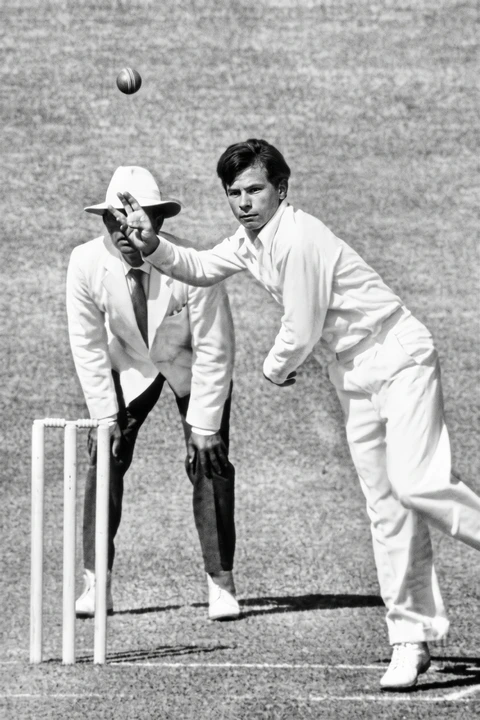
Paddy, as he was fondly called, was a left-arm orthodox spinner with exceptional talent. Unnerving accuracy and an ability to extract turn from wickets with just a hint of help served him well.
Vinoo Mankad, one of cricket’s legends, noticed him at a trial and offered him a job at a cotton mill in Mumbai. Shivalkar, who had never held anything but a tennis ball, had found a calling. Playing in the rough and tumble of Bombay’s amazing cricket circuit, he slowly grew in confidence. He caught the eye of Vijay Manjrekar and Madhav Mantri, the colossal doyens of Indian cricket, and soon Shivalkar was in with a chance of playing first-class cricket.
He made his debut for Mumbai in 1962 and kicked off a career that lasted for 26 years. It was a time when Mumbai was a dominant presence in the first-class cricket scene, and Shivalkar was a part of the march of Mumbai in the Ranji Trophy. He was a part of 18 of Mumbai’s 20 Ranji Trophy wins in those years.
In 124 matches, he grabbed 589 wickets with 42 five-wicket hauls and 13 ten-wicket hauls. All this at an average rate of two runs per over. He played for the Mumbai Ranji team till the 1980–81 season, a season in which Mumbai was crowned champions.
Paddy’s memorable rout of Tamil Nadu at Chepauk
The highlight of his career was his performance in the Ranji Trophy final of 1972–73. Tamil Nadu, in their own wisdom, and to gain a slight advantage from the presence of spinners like S Venkataraghavan and VV Kumar, produced an underprepared pitch.
The trick seemed to have worked as Bombay, with the likes of Sunil Gavaskar, Ajit Wadekar, and Dilip Sardesai in their ranks, crumbled to 151, with both Venkat and Kumar taking five wickets each.
When Tamil Nadu came into bat, they realised that their plans had backfired. The dusty, crumbling pitch and the conditions suited Shivalkar better. With his familiar three-step hop run-up and his accuracy, he dished out a masterclass. The ball was turning square on a dusty bowl of a pitch, and Tamil Nadu collapsed to a total of 80. Paddy returned with figures of 17-5-10-8. Mumbai managed just 113 in the second innings.
Tamil Nadu needed 185 to win. It was just the third day, and the wicket was already a minefield. Its underprepared nature and two days of wear had made it look like a ploughed paddy field. Shivalkar resumed where he left off, and Tamil Nadu did worse the second time around. Shivalkar took 5 for 23, bowling them out for 61. (The other five wickets were taken by Eknath Solkar, bowling spin.) Mumbai had won the Ranji Trophy for an astonishing 15th time in a row.
Tamil Nadu needed 185 to win. It was just the third day, and the wicket was already a minefield. Its underprepared nature and two days of wear had made it look like a ploughed paddy field. Shivalkar resumed where he left off, and Tamil Nadu did worse the second time around. Shivalkar took 5 for 23, bowling them out for 61. (The other five wickets were taken by Eknath Solkar, bowling spin.) Mumbai had won the Ranji Trophy for an astonishing 15th time in a row.
Lady Luck plays a miser
Despite being among the most economical and successful spinners of his time, Paddy never got the chance to represent India. The presence of the one and only left-arm orthodox spinner, Bishan Singh Bedi, meant that he never got a peek into the Indian Cricket team. It was the time when Indian cricket was well served by the famous spin quartet. Bedi, S Venkataraghavan, EAS Prasanna, and B S Chandrasekhar were wreaking havoc in the opposition ranks in international cricket with their spin wizardry. In Shivalkar’s own words, he and Rajinder Goel (another luckless unsung hero) were around at the wrong time.
In sports, like everywhere else in life, success is the result of inherent talent, hours of effort, and a bit of luck. The irony of the whole thing is the fact that it is the luck part that seems to be the dominant ingredient. Luck, as an attribute, is difficult to define and impossible to create.
The dictionary defines it as “success or failure apparently brought by chance rather than through one’s own actions.”
And yes , it is a noun and not a verb.
Noun or not, Padmakar Shivalkar did get a lesser share from Lady Luck’s disbursal. He confessed that it was quite a hard knock to take and struggled to cope with it. He, however, soldiered on, and Bombay cricket was served well. Shivalkar was a man with an interest in music and someone who would enjoy singing a song. Music certainly soothes and may well have kept him sane.
It was no surprise when, when asked how he handled the misfortune, he replied by quoting a Sahir Ludhianvi song from the iconic Dev Anand starrer Hum Dono.
Jo mil gaya usi ko muqaddar samajh liya, jo kho gaya main usko bhulata chala gaya. Main zindagi ka saath nibhata chala gaya, har fikr ko dhuen mein udata chala gaya.
(Whatever I received, I considered it my fate; what I lost, I chose to ignore; I kept on with life and blew every worry away.)
That was Paddy Shivalkar’s way of looking at a career that did not get the crowning glory.
–