
There is a village in Maharashtra where no one locks their front door. No padlocks on shop shutters. No deadbolts on homes. Not even a latch on the local bank. And yet, theft here is virtually unknown.
Welcome to Shani Shingnapur , a small, dusty settlement in Ahmednagar district, about 35 km from Shirdi, where an ancient belief in divine justice has replaced every lock and key for centuries.
I knew about it, but never had a chance to visit this enchanting village.
It is an early Sunday morning in May, and I am with some of my friends on my way to Aurangabad, a bustling industrial town a few hours from Pune. With about an hour to go and the sun brightening up, we decided to take a break at one of those highway hotels that serve as a stop for the wayfarer.
We ignored the solidly built shops with colorful signboards and chose a shack that served just tea and some local cones and biscuits. Towards the back of the shop, on a table stood a gas stove with a teapot. On the brownish, smoke-stained wall behind hung a date calendar. It was in the local Marathi script, which is akin to Hindi script. While the dates lined the bottom of the sheet, the center was taken by the photograph of an elegant godlike form riding a peacock. The bold yellow font in the corner said, “With the blessings of Lord Shani.” I realized that this was Lord Saturn territory. The Shani Shingnapur temple, one of the very few temples in India dedicated to Lord Shani (Saturn), was not far away.
I had been thinking of visiting the temple for a long time, and it struck me that it would be a good idea to seek blessings today.
The Legend
The story behind Shani Shingnapur reads like it was lifted straight from ancient scripture and perhaps it was.
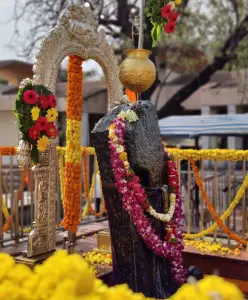
Legend has it that long ago, a shepherd poking at a black stone was startled when it began to bleed. The frightened villagers gathered, unable to explain what they had witnessed. That night, many of them dreamed of the same figure: Lord Shani, who revealed that the stone was his earthly form. When asked whether a temple should be built to house it, he refused while instructing that the stone remain open to the sky, unroofed and unenclosed, as it stands to this day.
Lord Shani also made a promise: the village and its people would be protected from theft and robbery. Anyone who dared steal within its boundaries, the legend warns, would face swift and certain retribution.
The villagers believed him. And they have never stopped believing. So even as the hamlet grew up in size, gained importance, and turned slowly into a bustling village , it never felt the need for protecting its property.
The Shani Shingnapur Temple
Shingnapur is a typically dusty village with narrow lanes and brown buildings. The main street is lined with shops selling stuff that devotees offer to the Lord Shani, and the pavements are taken by hand carts carrying souvenirs, toys, and, in some cases, wilted yellow Robusta bananas with dark patches.
Shani Shingnapur is a place that owes its busy life to the Shani Temple (a temple dedicated to Lord Shani (Saturn).
In Hindu astrology, Saturn (Shani) is considered among the most powerful planetary influences on one’s life. A favourably placed Saturn at birth can bring discipline, perseverance, and eventual success; a malefic position is believed to bring hardship and misfortune. Many devotees come not just out of devotion, but to seek leniency and to request that Lord Shani be gentle with whatever karmic accounting awaits them.
The temple in itself is not a temple as you would normally see in India; the presiding deity is in the form of a black rock, open to the sky. No arches, no gates, and no sanctums—just a deity represented by a rock in the open.
The Lockless Village
The shopkeepers on the streets, when going for lunch, just cover their wares with a cloth and walk away. The houses that line the street and the by lanes have no doors; just curtains of various colors sway in the mild afternoon breeze. If there are any doors, they are without locks. The doors and curtains are more for privacy than for protection.
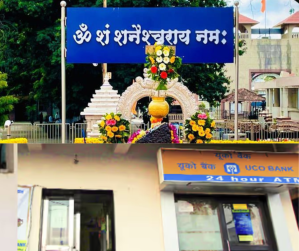
It has a bank that has doors but no visible locks. There is no fear of losing something to a quicksilver pickpocket or a grab-and-run on the streets. The trust in Saturn keeps all secure, and the fear of retribution keeps the vile away. The police station hardly receives any complaints of theft as peace prevails.
Thousands of devotees visit the temple looking for blessings or a plea to be kind in retribution. Saturdays, the day of Saturn, see crowds thronging the temple. The other days have less footfall. On the no moon day, which is supposedly the best day to appease the god, the crowds swell to almost 300,000 a day.
Leaving Shani Shingnapur — and What Stays with You
It is not a busy day, and I could get in and pray to the deity with little trouble. Having offered prayers, we resumed our travel to Aurangabad.
The road twisted itself out of the town, and the sugarcane fields reappeared. The folks in the field looked happy. The crops swayed in the mild wind, and even the by now harsh sun did not seem to worry anyone. The land was safe and sound in the hands of the Lord, and all of it seemed to amble away in peace.
What lingers after Shani Shingnapur is not the temple’s visual drama, it has none, really. What stays is the idea: that an entire community has chosen trust over suspicion, belief over bolts, for hundreds of years. Whether you are a devotee, a sceptic, or simply a curious traveller, there is something in that which deserves a moment of reflection.
All that happens here, good, bad, fortunate or otherwise is understood as the result of one’s own karma, settled patiently by Lord Shani, the great bookkeeper of deeds.
Sab Shani ki kripa hai. It is all Lord Saturn’s grace.
Leave it to the Lord Shani, the bookkeeper of karma.